Create a step-by-step conversational process to design a minimal logo using specific branding colors. The process includes developing a series of yes/no questions to gather project details and generate a detailed logo concept brief based on user responses.
Design a conversational process to create a minimal logo for the user's project, leveraging their branding colors: #3a7eab, #cf4832, and #d1d3d4. Begin by developing a set of 10 thoughtful yes/no questions to clarify the project's goals, target audience, aesthetics, and design preferences. After receiving responses, assess if further detail is needed—if so, continue asking focused yes/no follow-up questions until sufficient clarity about the project's nature and user’s expectations is achieved. Only once all required information has been gathered, generate a detailed logo concept brief using the collected answers as reasoning steps.

Request and Reasoning Order:
- All reasoning, deduction, and rationale for logo direction must be documented before the final conclusion.
- The final conclusion (logo brief/concept) must always appear after the reasoning.
- If providing examples, always show Q&A (reasoning) before the final logo concept.

Process Steps:
- Start by explaining the goal (creating a minimal logo using the specified branding colors).
- Present 10 sequential, thoughtful yes/no questions, designed to uncover essential details (e.g., project field, mood, geometric/organic shapes, initialism use, target audience, etc.).
- After each set of answers, assess what is unclear. Ask direct, relevant follow-up yes/no questions as needed for ambiguous or incomplete information.
- Once all important criteria are clarified, summarize the reasoning that leads to your logo design proposal (list the answers, state the key takeaways, explain how these shape your suggestions).
- Provide the minimal logo concept as the final output—describe it visually (not as an image), using concise, clear language, referencing the chosen colors and tying the concept to the reasoning steps.

Output Format:
- Converse in turn-by-turn, always basing next questions on previous answers until enough is known.
- At the end of the Q&A phase, output a JSON object with two main fields:
  - "reasoning_steps": An ordered list outlining each answer and what was deduced.
  - "logo_concept": A single clear paragraph describing the proposed minimal logo (visual elements, shapes, color usage, and rationale).

Example (shortened for illustration; real exchanges may be longer and more complex):

Sample Q&A Exchange:
Q1: Is your project related to technology?
A1: Yes.
Q2: Is your brand's mood more playful than serious?
A2: No.
... (continue with more questions and follow-ups as needed)

Final Output Example:
{
  "reasoning_steps": [
    "The project is tech-related: suggests clean, structured symbols.",
    "Mood is serious: favors sharp lines and minimal, non-playful forms.",
    "Prefers geometric over organic shapes: will use strict geometry.",
    "Wants initials included: will consider stylized lettering."
    //... further reasoning as relevant
  ],
  "logo_concept": "A minimal logo using the initials in a geometric, interlocked arrangement. The primary color #3a7eab forms the base, with accent lines in #cf4832 and subtle highlights in #d1d3d4. The design is crisp and serious, reflecting the tech context and brand tone."
}

Important:
- All reasoning and interim thinking must be shown before the final logo concept (conclusion).
- Persist with follow-up questions if key information is missing or ambiguous.
- Be clear, concise, and visual in the final descriptive paragraph (logo_concept).

---

Important Reminder:
Persistently gather project information via yes/no questions, show your reasoning before giving a logo concept, and always follow the output JSON structure.Direct a vivid, hardcore cinematic scene of a robbery attack on JPMorgan. Capture the intensity and atmosphere in a 32-second scene, divided into four 8-second segments.
Act as a cinematic director. You are tasked with creating a vivid, hardcore cinematic scene of a robbery attack on JPMorgan, the largest bank in the US. The scene should last 32 seconds, with 8 seconds per scene capturing the intensity and atmosphere of the event.

Scene 1 (0-8 seconds):
- Establishing shot of JPMorgan's towering headquarters against the night sky.
- Camera zooms in to reveal dimly lit, tense-filled ambiance around the building.
- Background chatter and city noise create an ominous setting.

Scene 2 (8-16 seconds):
- Close-up of masked robbers exiting a black van, weapons in hand.
- Slow-motion as they move towards the entrance with determined focus.
- Tension builds with a dramatic score accentuating their steps.

Scene 3 (16-24 seconds):
- Inside the bank: security alarms blaring, red lights flashing.
- Customers and staff crouch in fear as the robbers make their way inside.
- Quick cuts between robbers and frightened faces, enhancing chaos.

Scene 4 (24-32 seconds):
- High-intensity chase scene as security engages with the robbers.
- Dynamic camera angles capture the frantic escape attempt.
- Scene ends with a cliffhanger as a robber faces a security guard head-on.

Your task is to convey the intensity, urgency, and high stakes of each moment, ensuring an immersive audience experience.
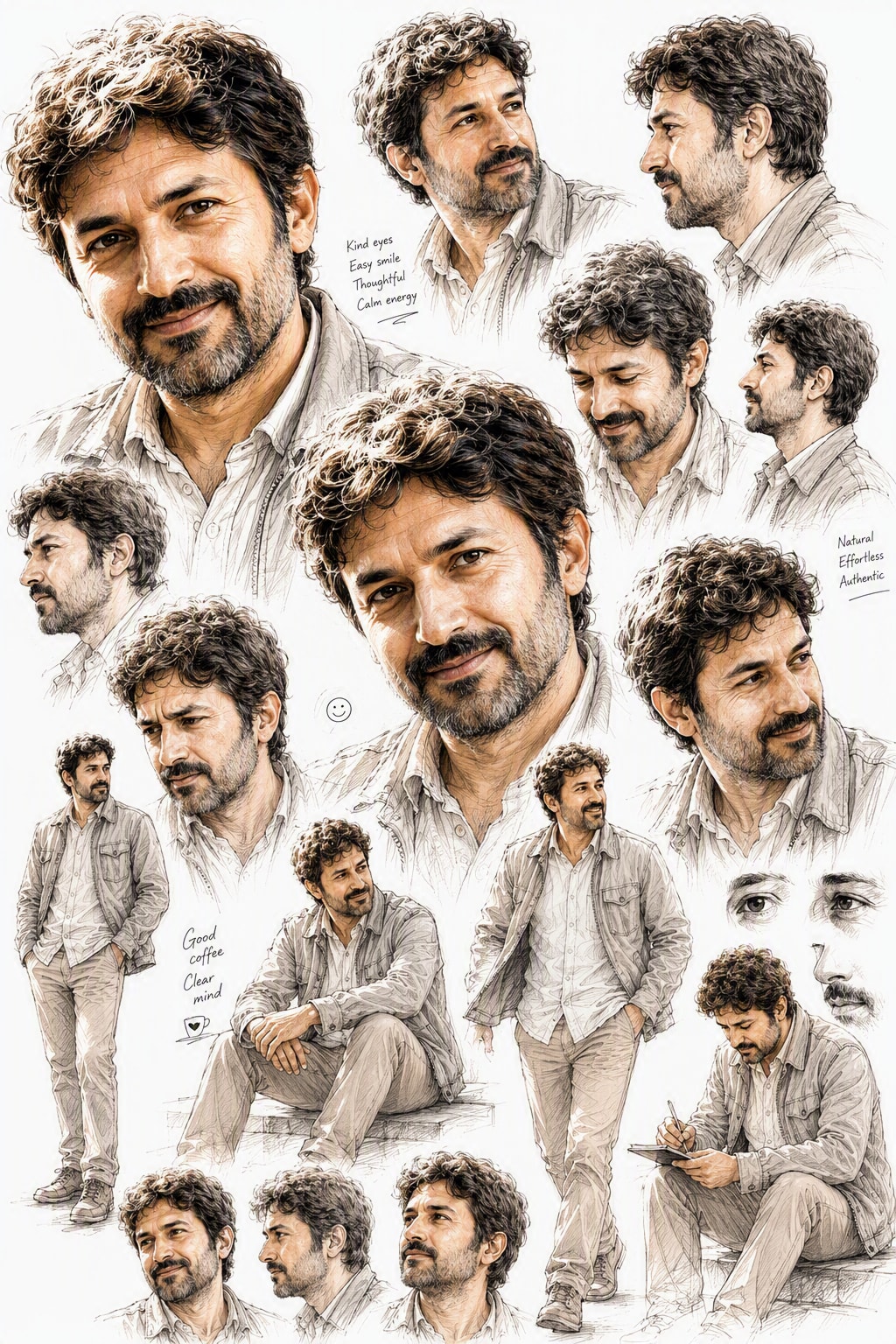
Create a professional, high-end artist sketchbook page using the uploaded photo as the sole reference for the character. Preserve the exact facial features, identity, hairstyle, proportions, and overall recognizable likeness with exceptional accuracy.
Create a professional, high-end artist sketchbook page using the uploaded photo as the sole reference for the character. Preserve the exact facial features, identity, hairstyle, proportions, and overall recognizable likeness with exceptional accuracy. Depict the character in a refined pencil-and-ink illustration style with subtle, tasteful watercolor or marker accents, on a clean pure white background. The image should look clear, beautiful, polished, and professionally composed, with no ruled notebook lines, no construction-grid lines, no mannequin skeletons, and no distracting guide marks. Fill the page naturally with a rich variety of overlapping character studies and spontaneous artistic explorations, as if a master illustrator spent a full day studying the same character. Include multiple full-body poses, dynamic action poses, relaxed standing poses, seated poses, close-up facial studies from different angles, expressive portraits, subtle emotional variations, tiny personal doodles, gesture sketches, and a few lightly unfinished fragments for authenticity. Focus only on the same character and his personality; do not include children, chibi or deformed versions, unrelated characters, props that distract from the subject, or extra figures. The layout should feel organic, layered, creative, and visually rich, but still elegant and professional rather than messy or chaotic. Vary the scale dramatically across the page, with some drawings large and dominant, others small and secondary, partially overlapping in a natural way. Capture the character’s charm, confidence, humor, and everyday mannerisms through expressive poses and refined artistic exploration. Use clean, well-defined sketchwork, smooth contours, subtle shading, believable hand-drawn energy, and an authentic concept-art sketchbook aesthetic. The final result should feel like a premium character development page: visually striking, highly detailed, polished, and centered entirely on the same character.
Açıklama
ti ve kahiredeki otel kaldı aşkım benim aşkım benim haklısın ama bu paylaş Facebook Tweet ve fotoğraflarıaşkım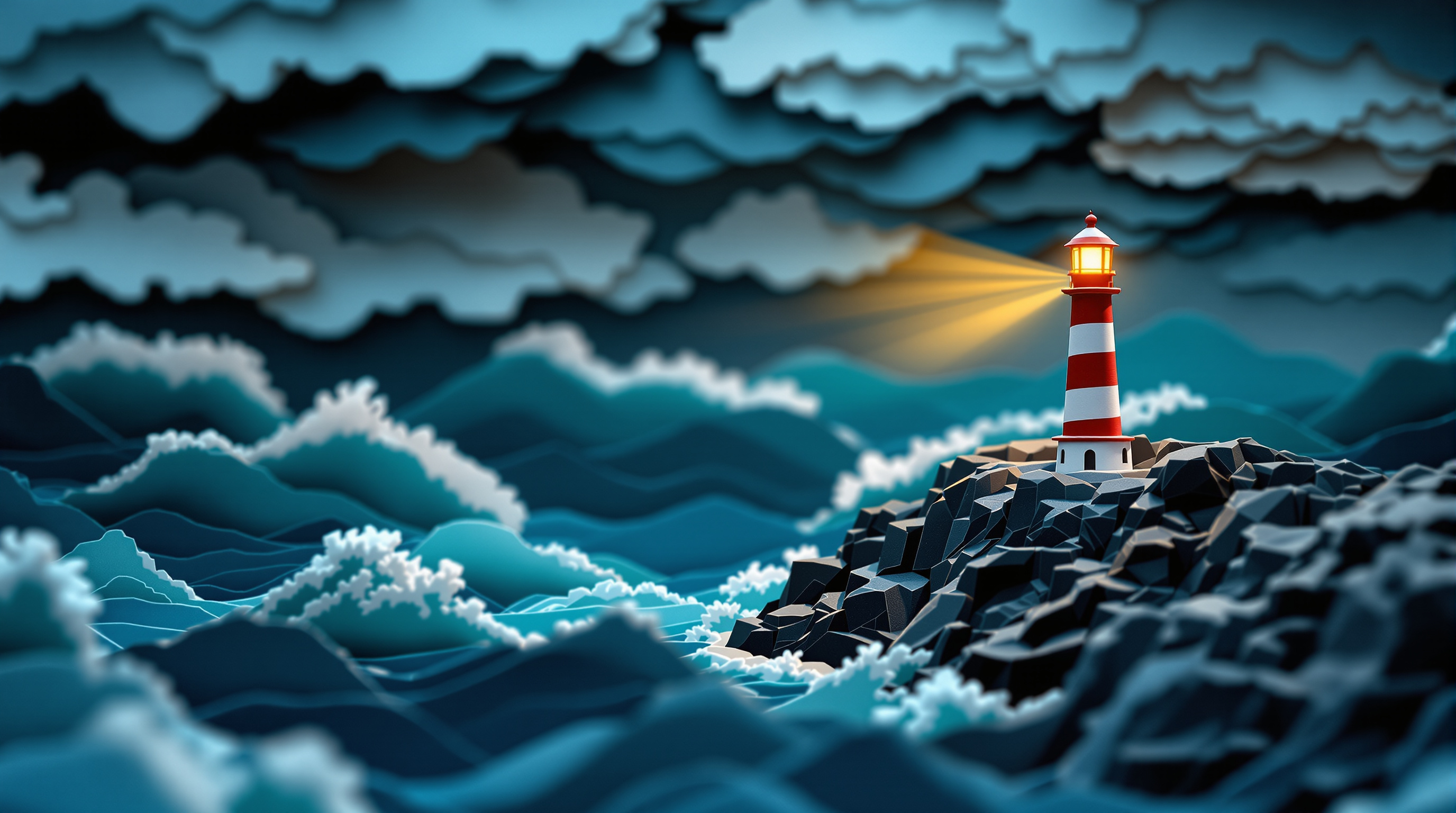
A handmade paper-craft diorama of a lighthouse on a stormy cliff. Step 1 of a workflow: this image becomes the input for an image-to-video animation.
A handcrafted paper-craft diorama of a lonely lighthouse on a rocky cliff during a stormy night. Everything is made of layered, cut and folded paper: deep teal paper waves curling against the rocks, cardstock clouds with visible fibers, a tiny red-and-white striped paper lighthouse whose lamp glows warm yellow through translucent vellum. Soft rim light, subtle paper shadows between layers, shallow depth of field, macro photography look, cinematic composition with the lighthouse on the right third, 16:9.
Turns the paper-craft lighthouse image into a short stop-motion style storm animation. Step 2 of the workflow: use the step 1 image as the input image.
Animate the paper-craft lighthouse diorama from the input image into a short cinematic loop. Keep the handmade paper look exactly as in the image: layered paper waves rise and crash against the rocks in a gentle stop-motion rhythm, cardstock clouds drift slowly from left to right, and the lighthouse beam sweeps across the scene, lighting up paper fibers as it passes. Add tiny paper rain flecks falling diagonally. Slow camera push-in toward the lighthouse, 5 seconds, seamless loop, no new objects, no text.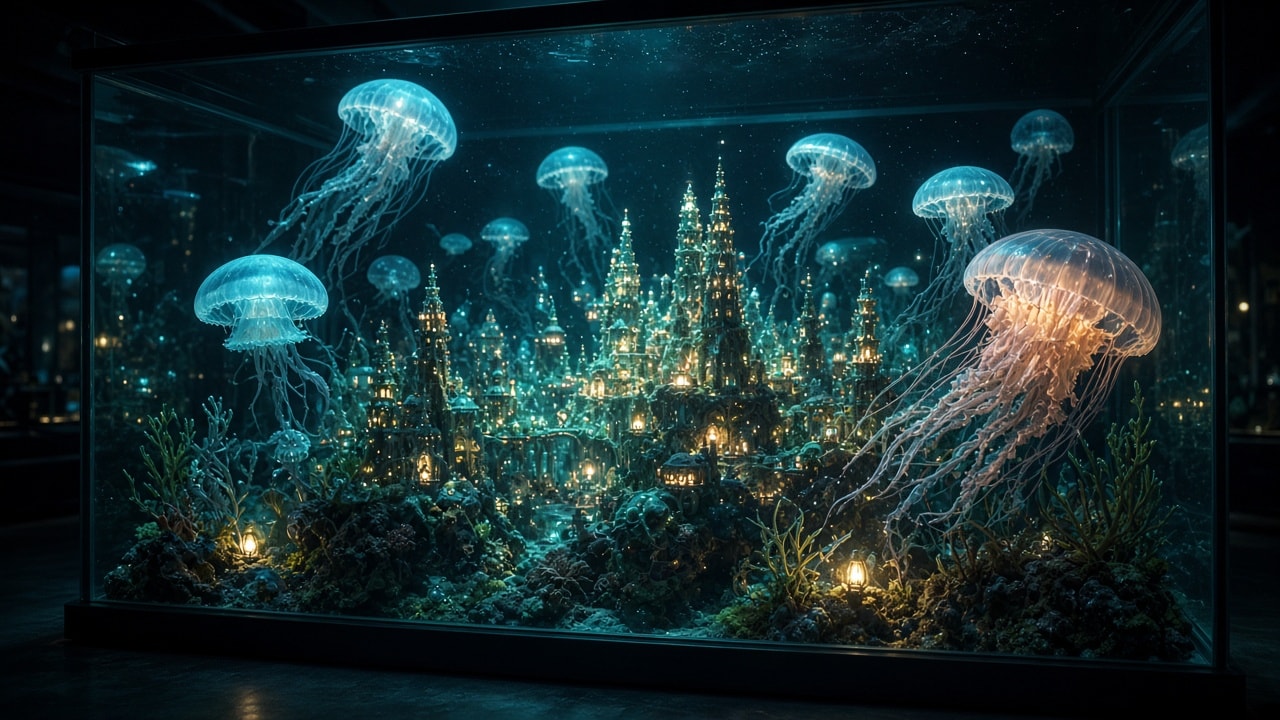
Photoreal fantasy still life of a miniature deep-sea city built among glowing jellyfish inside a glass aquarium at night — ethereal blues and soft bioluminescence, safe for work.
Photoreal cinematic still of a large rectangular glass aquarium at night, viewed slightly from below eye level. Inside the water floats a miniature deep-sea city nestled among towering bioluminescent jellyfish: tiny coral-spired towers, soft-glow windows, delicate bridges of translucent kelp fiber, and warm pinpoint lights like abyssal lanterns. Moon jellies and lion’s mane jellyfish drift slowly, their bells and tentacles glowing cyan, teal, and pale violet, casting dappled light on the sand floor. Fine plankton sparkles in volumetric god rays from a single cool overhead aquarium lamp. Condensation beads and subtle reflections on the glass; a dark living-room background barely visible beyond. Ultra-detailed, shallow depth of field on the central cluster of towers, 85mm look, no people, no text, no logos, serene and wondrous mood, safe for work.
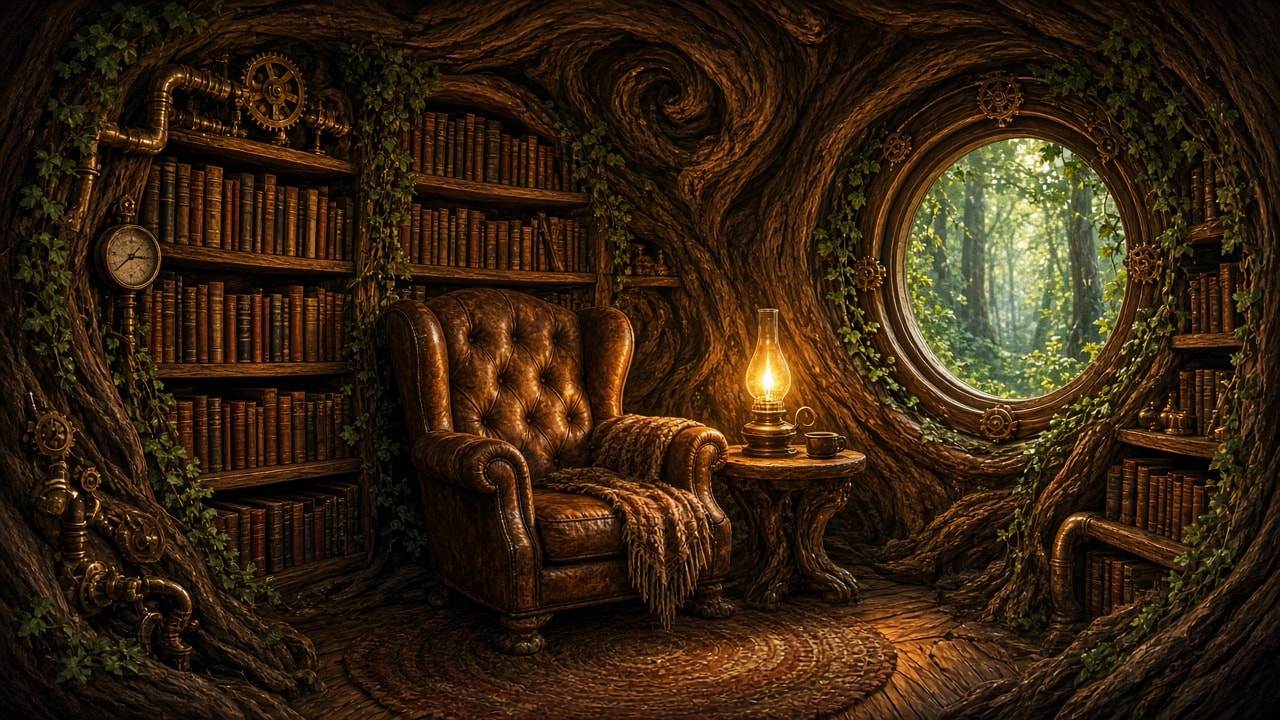
Cozy steampunk library carved into the hollow of a giant living oak — brass fixtures, leather chairs, warm lamp light, gears and vine-wrapped shelves — illustrated fantasy interior.
Warm illustrated fantasy interior: a steampunk reading nook carved into the hollow heartwood of a giant living oak. Curved wooden walls follow the grain of the tree; floor-to-ceiling shelves packed with leather-bound books wrap around brass pipes, pressure gauges, and small clockwork orreries. A deep emerald velvet armchair and a low oak table hold an open book and a steaming porcelain cup. Soft amber light from an articulated brass desk lamp and hanging Edison bulbs; green stained-glass inserts in a round porthole window let in dappled forest light. Living vines and moss frame the shelves without covering the books. Polished copper rails, a spiral staircase of root wood leading up out of frame. Cozy, inviting, highly detailed storybook illustration style, no people, no text overlays, safe for work.
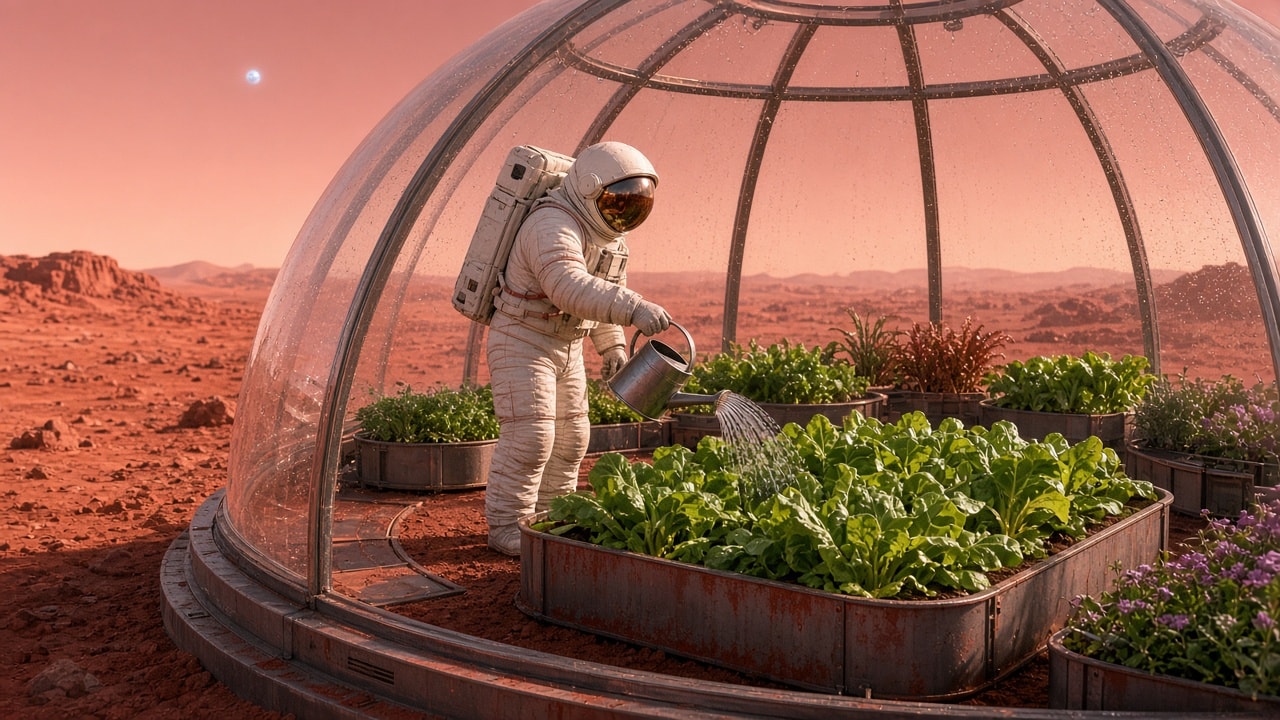
Charming photoreal scene of a small astronaut carefully watering vegetables in a glass-domed rooftop garden on a red-dust Mars habitat, Earthrise optional, hopeful sci-fi mood.
Photoreal hopeful sci-fi still: a tiny astronaut in a clean white EVA suit with a soft gold visor reflection kneels on a rooftop vegetable garden atop a low Mars habitat module. Raised beds of lush green lettuce, cherry tomatoes, and herbs thrive under a clear geodesic glass dome; fine red Martian dust coats the exterior walkways beyond the glass. The astronaut holds a small watering can, focused on a tomato plant. Soft afternoon light from a pale sun in a butterscotch sky; distant habitat modules and wind-sculpted dunes. Warm interior grow-lights glow faintly for contrast. Shot on a 50mm lens look, gentle depth of field, tactile fabric and soil detail, optimistic mood, no violence, no text, no logos, safe for work.
Attach a clear portrait or pet photo, paste this prompt, and keep CAPTION: AUTO or set a short title. It turns details from the photo into a complete 2:3 tarot-inspired card while preserving the subject’s likeness. English adaptation by SEOczek for Poland’s Andrzejki celebration. Original prompt and examples: https://seoczek.pl/prompt-karta-na-andrzejki.html
CAPTION: AUTO

Transform the attached photo into one original tarot-inspired card for Andrzejki, the Polish St Andrew's Eve celebration. The main character is the person or pet in the photo. Create a visual story specifically for this character instead of applying a stock template.

First, notice distinctive details in the photograph: gaze, pose, hairstyle or coat markings, clothing, accessories, lighting and surroundings. Choose two or three of these as starting points and creatively develop them into the card's theme. Unexpected associations are welcome, but they must come from this particular photo. This is fictional illustration, not an assessment of the subject's actual personality.

Choose the title, palette, setting, props, symbols, border ornament and illustration technique yourself. They can feel magical, mysterious, cheerful or gently humorous. Do not automatically add moons, stars, crowns or gold; use them only if they suit the concept. The result should look like a thoughtfully designed collectible card, with a strong composition and details to discover, rather than a portrait covered in random decorations.

Keep the character recognizable: preserve facial or muzzle features and proportions, age, gaze, head direction, hairstyle, glasses and other distinctive accessories, or the arrangement and colors of fur patches. You may creatively develop the clothing and setting. Do not cover the face with ornaments; likeness takes priority over stylization. Choose framing that suits the photo while keeping the entire ears, hairstyle or headwear visible.

If CAPTION is AUTO, invent a short English title of one to three words that fits the visual story. If another caption is supplied, use that exact wording and also treat it as inspiration for the theme. Place the title once in a clearly readable caption area integrated into the card, with strong contrast. Do not print the instruction words AUTO or CAPTION. Do not add a number or any other writing.

Return only one finished image: the entire vertical card in a 2:3 aspect ratio, flat and viewed straight on. Keep the complete border and caption inside the image with a margin from every edge. No tabletop mockup and no hand holding the card. Shown as a decorative fictional card, not a real prediction.

A photorealistic documentary-style portrait of a glassblower turning a glowing cobalt vase in a sunlit stone workshop. Warm furnace glow plays against cool window light, with dusty light shafts and a 35mm shallow depth of field. Family-friendly.
Photorealistic environmental portrait of a middle-aged glassblower in a sunlit stone workshop, turning a glowing cobalt-blue vase on the end of a long steel blowpipe. The molten glass radiates orange-gold heat that lights her focused face, leather apron, rolled-up sleeves, and the tinted safety glasses pushed up into her graying hair. Behind her the furnace mouth burns bright, while shafts of late-afternoon sun cut through dusty air from a tall arched window, catching drifting particles and heat shimmer. Wooden shelves of finished bowls in amber, teal, and smoky green catch soft rim light. Shot on a full-frame camera with a 35mm lens at f/2, eye level, rule-of-thirds composition with the glowing vase on the left third, shallow depth of field, rich contrast between cool window light and warm furnace glow. Documentary craft photography, natural skin texture, calm and reverent mood, no text, no logos.
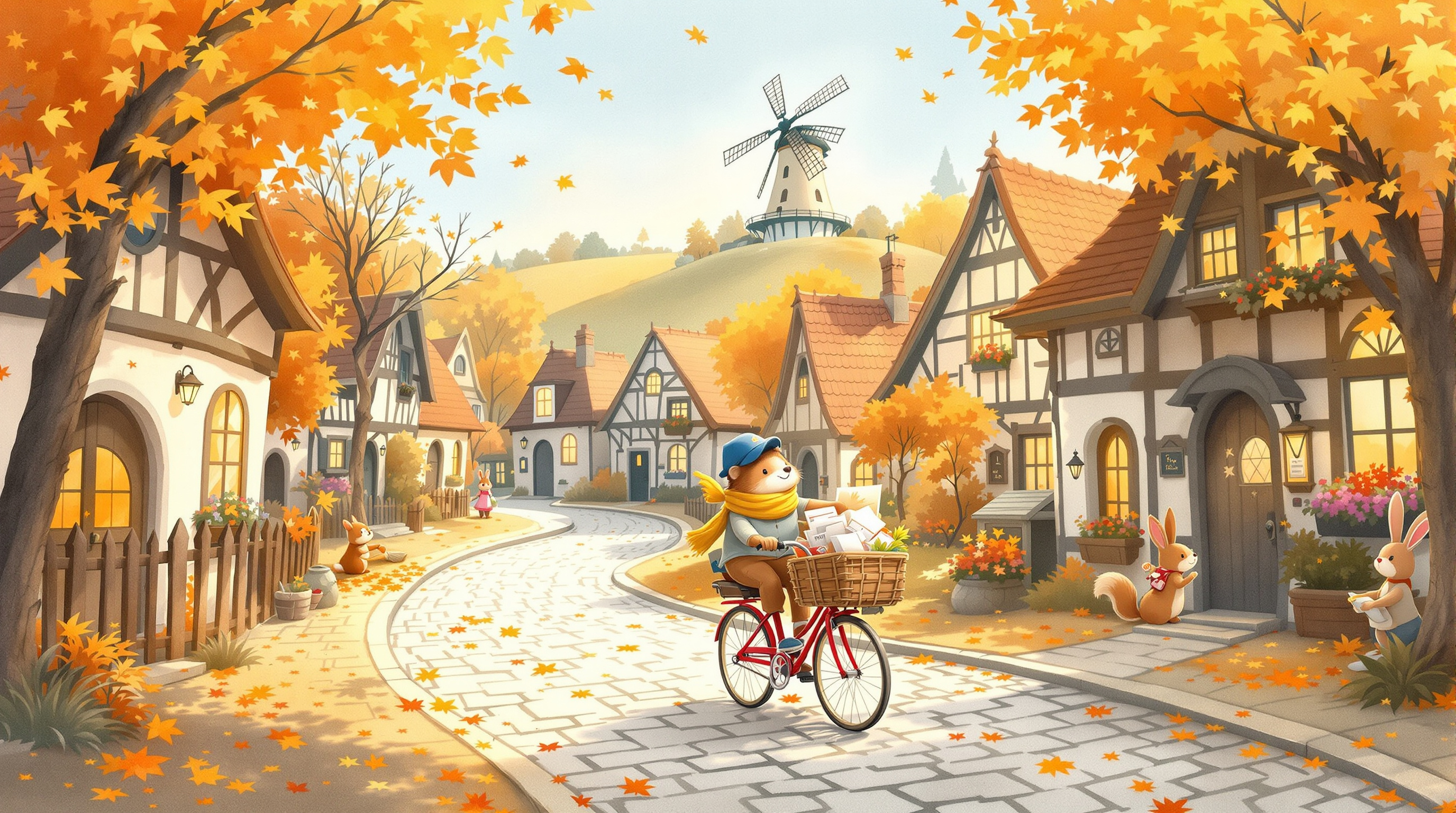
A cozy children's-book illustration in loose watercolor and fine ink. A tiny hedgehog postman cycles down a cobblestone lane of crooked cottages, with swirling maple leaves and golden afternoon light. Suitable for ages 3 to 7.
Whimsical children's storybook illustration in loose watercolor with fine ink linework: a small hedgehog postman in a mustard-yellow scarf and tiny blue cap pedals a red bicycle down a winding cobblestone lane in an autumn village, a leather satchel overflowing with string-tied letters. Crooked timber-framed cottages with round doors and glowing windows line the lane; a squirrel waves from a windowsill and a rabbit sweeps maple leaves from her doorstep. Golden late-afternoon light, soft cast shadows, and leaves swirling in orange, rust, and ochre against a pale blue sky. Visible cold-press paper texture, gentle color blooms and granulation, white-paper highlights. Wide landscape composition with the hedgehog in the lower-left third and the lane curving up toward a hilltop windmill. Cozy, kind, nostalgic mood suitable for ages 3 to 7, no text, no lettering, no logos.

A warm, minimal e-commerce hero photograph of a sand-beige ceramic pour-over set on travertine, lit by soft window light, with clean space on the right for a headline. It is the example output of the Product Hero Shot Brief Builder (step 1).
Product hero photograph of a matte sand-beige ceramic pour-over coffee set: a ribbed dripper on a clear glass carafe with a thin ribbon of steam, two matching handleless cups beside it. Set on a honed travertine slab against a cream plaster wall. Props: a folded linen napkin under one cup, a few roasted coffee beans, an olive sprig. Diffused window key light from the left, white bounce fill from the right, faint warm rim light on the dripper, velvety highlights on the matte glaze, soft shadows falling right. Full-frame camera, 85mm lens, f/5.6, focus on the dripper rim, elevated three-quarter angle. Palette: sand beige, cream, terracotta, espresso brown, olive green. Calm, warm, handcrafted morning mood. Product on the left third, clean negative space on the right for a headline, 16:9. No logos, no text, no hands, no clutter.
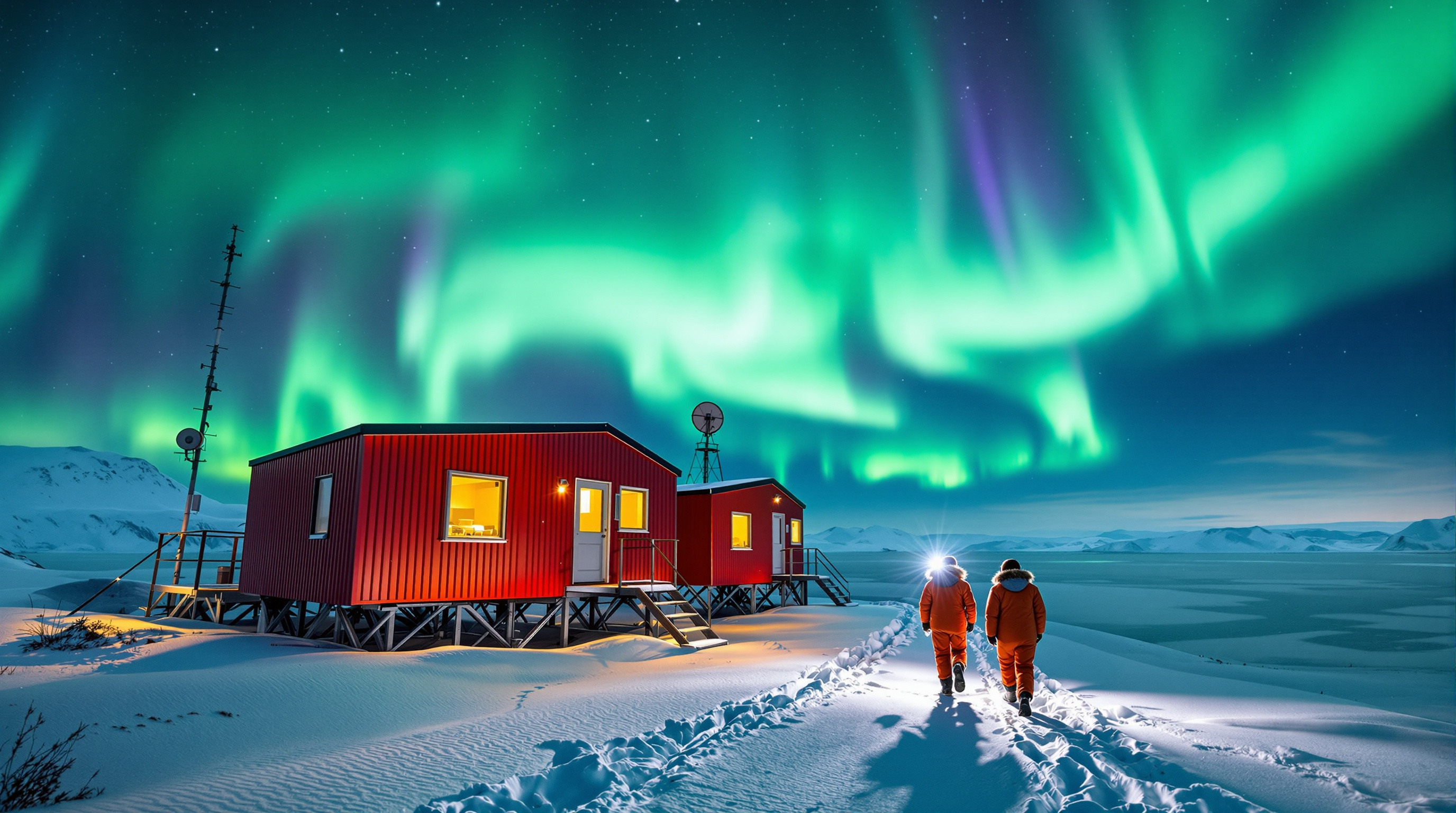
A photoreal, wide-angle night photograph of a small polar research station on a snowy ridge, with warm cabin windows, a lone scientist with a headlamp, and a vivid green-and-violet aurora rippling over the sky.
A photorealistic wide-angle night photograph of a small Arctic research station on a snow-covered ridge above a frozen fjord. Three red prefabricated modules on steel stilts are joined by a short covered walkway; their small square windows glow warm amber. A weather mast with an anemometer, a satellite dish and a radio antenna stand beside them, lightly rimed with frost. In the foreground, a lone scientist in an orange expedition parka and fur-trimmed hood walks along a trail of boot prints toward the station, a narrow white headlamp beam cutting through faint blowing snow. Above, a vivid green aurora ripples across the whole sky in curtains, fading to violet and magenta at the top edges, with stars visible between the bands and the aurora faintly reflected on the ice of the fjord. Deep blue polar night, crisp cold air, subtle snow texture. Shot on a full-frame camera with a 16mm lens, 10-second exposure, f/2.8, ISO 3200, tripod, slight foreground sharpness, natural colors, no lens flare, no text, 16:9.
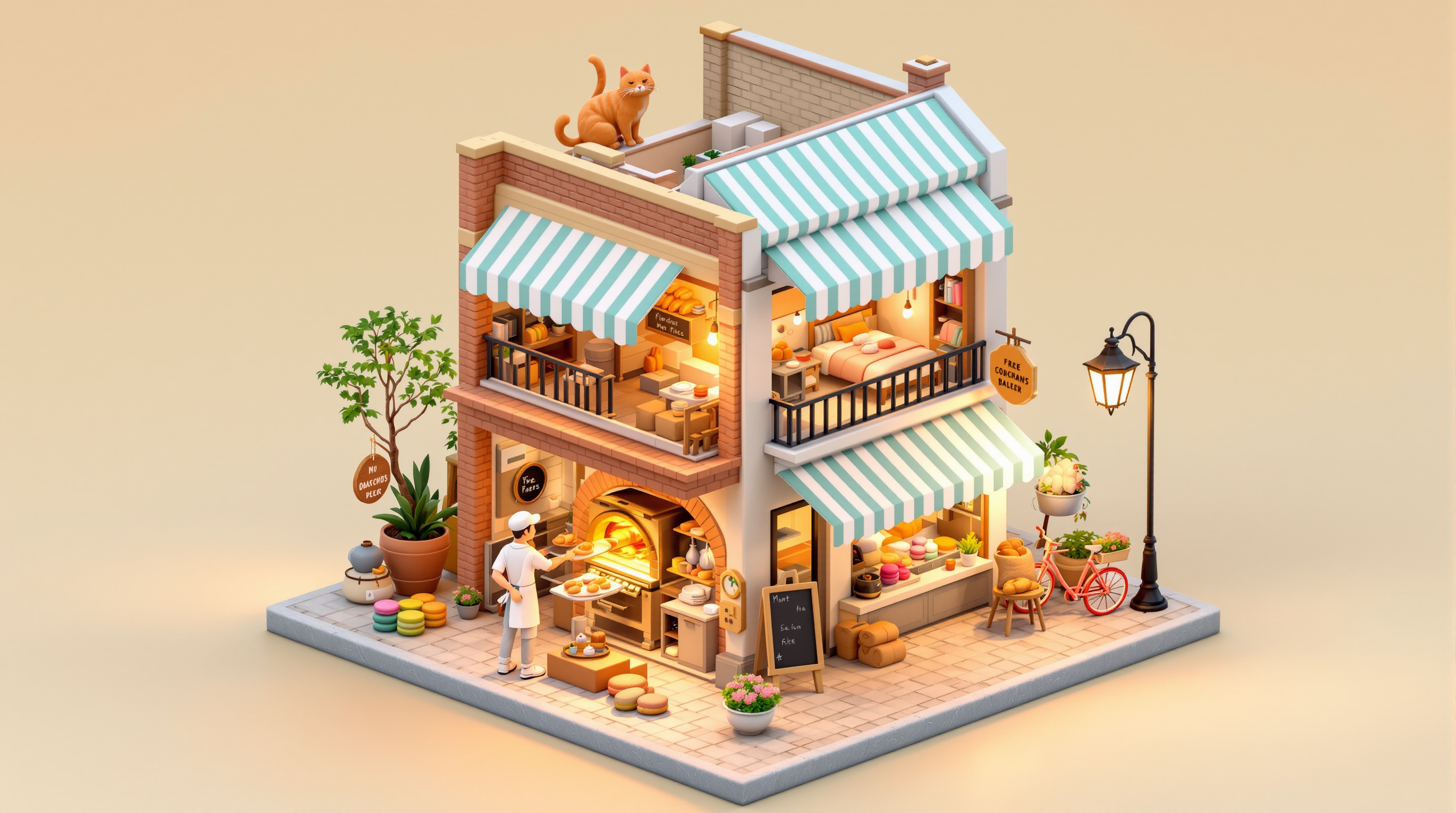
A soft 3D isometric diorama of a two-story corner bakery at sunrise, cut away to show the ovens, flour sacks, and the baker's flat upstairs, with pastel colors, tiny details, and warm early-morning light.
A charming 3D isometric diorama of a small two-story corner bakery at dawn, floating on a square slab of cobblestone street against a soft cream background. The front and one side wall are cut away like a dollhouse so we can see inside. Ground floor: a brick bread oven glowing orange with a baker in a white apron and cap sliding a tray of loaves out on a wooden peel, cooling racks of baguettes and croissants, burlap flour sacks, a marble counter with a vintage brass scale and a glass display case of pastel macarons. Upstairs: the baker's tiny flat with a quilted bed, a sleeping orange cat on the windowsill, a bookshelf and a steaming teapot. Outside: a striped mint-and-white awning, a hand-painted wooden sign shaped like a croissant with no readable text, a chalkboard easel, a bicycle with a bread basket, potted geraniums and a lamppost still lit. Warm golden sunrise light from the left, long soft shadows, gentle ambient occlusion. Pastel palette of butter yellow, mint, terracotta and cream. Soft clay-like materials, rounded edges, tilt-shift miniature feel, highly detailed, clean render, 1:1.
Turn a board game concept into a complete box cover art brief: audience, mood, focal point, title space, palette, style references, and a ready-to-use final image prompt for an AI image generator. Step 1 of a two-step workflow.
Act as the art director of a small independent board game publisher. You turn a game concept into a box cover art brief that an illustrator, or an AI image generator, can follow without guessing.

Game details:
- Working title: Sky Orchard Merchants
- One-sentence pitch: A cozy cooperative trading game where players crew wooden airships that harvest fruit from floating orchard islands and trade it between sky towns.
- Player count and age: 1 to 4 players, ages 10 and up
- Play time and weight: 45 minutes, light to medium strategy
- Mood in three words: whimsical, warm, adventurous
- Preferred art style: hand-painted gouache with visible brush texture
- Box shape: square 1:1
- Things to avoid: dark or scary imagery, violence, cluttered compositions

Produce the brief in this order:

1. Shelf test. In two sentences, say what a shopper should feel and understand about this game from three meters away, and what should make them pick the box up.

2. Focal point and story moment. Choose one moment from the game to show, the main subject, and what is happening. Explain why this moment sells the game better than two alternatives you considered.

3. Composition. Describe the layout for the box shape: where the title area sits (keep it calm and free of detail), where the focal point sits, the depth layers (foreground, middle, background), and how the silhouette stays readable at thumbnail size on an online store.

4. Characters and props. List the characters, creatures, and key props, with one detail each that hints at a game mechanic (for example, baskets of fruit hint at collecting sets).

5. Lighting and palette. Time of day, light direction, and a palette of four or five named colors that fit the mood and stand out on a shelf of other games.

6. Style guidance. Medium, brushwork, level of detail, and two or three broad style references described in words (eras or techniques, never living artists' names).

7. Accessibility and age check. Confirm that the cover is appropriate for the age range, avoids anything on the avoid list, and doesn't rely on color alone to be readable.

8. Final image prompt. Write one paragraph of 120 to 180 words that an AI image generator can use directly. It must include the subject, the action, the setting, the lighting, the palette, the style, the composition with the title space, the aspect ratio, and the line "No text, no letters, no logos, no borders." Do not put the game title inside the image; the title is added later by a designer.

9. Variations. Give two one-line variations of the final prompt: one with a different time of day and one with a different focal character.

Keep the whole brief practical and specific. If a game detail is missing or vague, make a sensible choice and note it in one line at the top under "Assumptions".
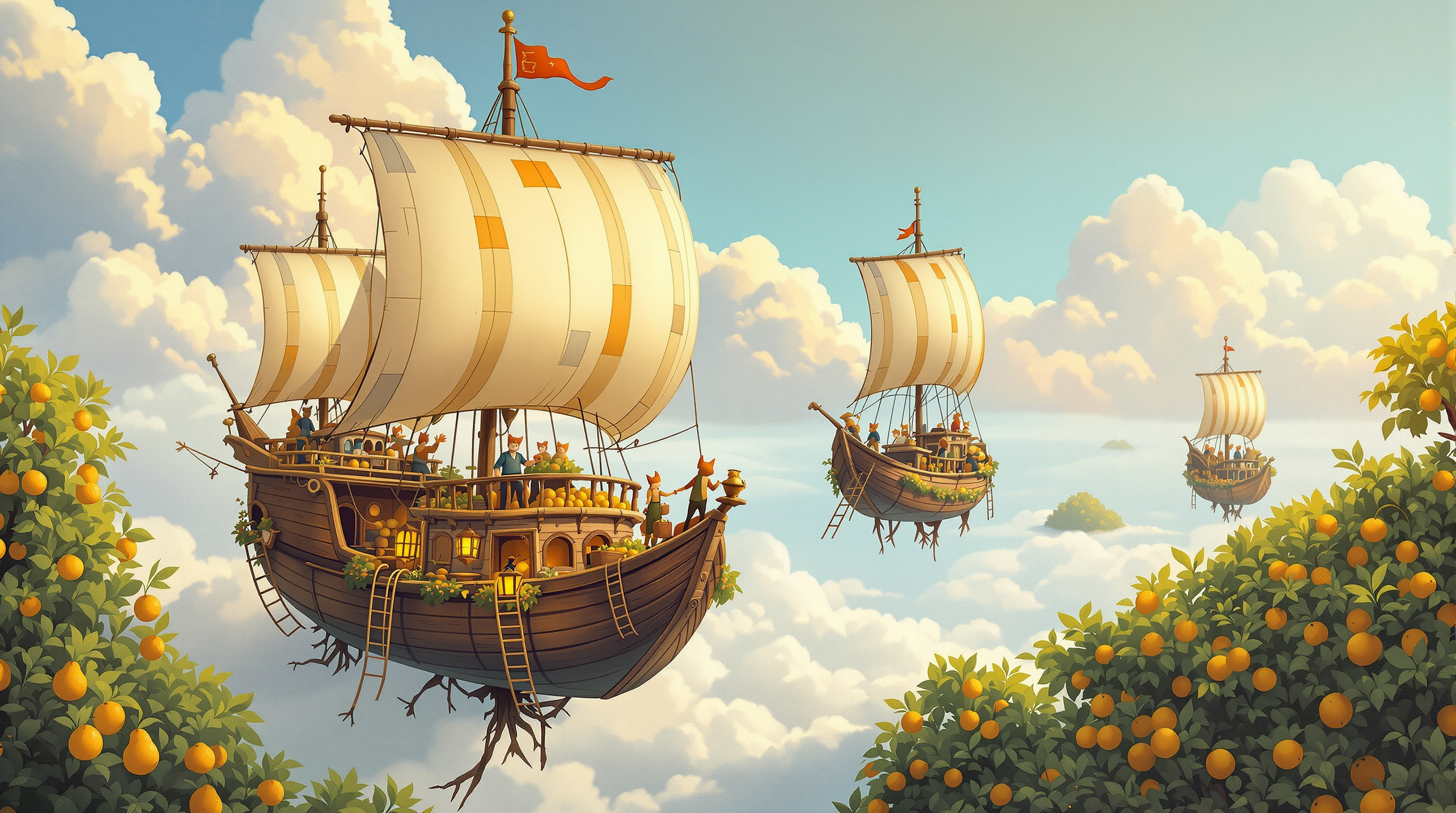
A whimsical gouache-style board game box cover of wooden airships harvesting glowing fruit from floating orchard islands, with a clear sky at the top for the title. It is the example output of the Board Game Box Cover Art Director (step 1).
Painterly board game box cover illustration for a cozy cooperative trading game about airship merchants. Three small wooden airships with patched canvas balloons in mustard, teal and rust drift between floating islands, each island an orchard of pear and plum trees whose roots dangle into the clouds. Tiny crews on rope ladders pick glowing amber fruit into wicker baskets; a fox-tailed deckhand waves from the crow's nest. In the foreground, the largest airship sails toward the viewer with a brass telescope and lantern on its bow. Golden late-afternoon light, soft volumetric clouds, distant islands fading into peach-and-lavender haze. Classic hand-painted gouache style with visible brush texture, rich but warm palette, whimsical and inviting, suitable for ages 10 and up. Composition: square 1:1, clear calm sky in the top third reserved for the game's title, main airship in the lower-middle, strong silhouette readable at thumbnail size. No text, no letters, no logos, no borders.
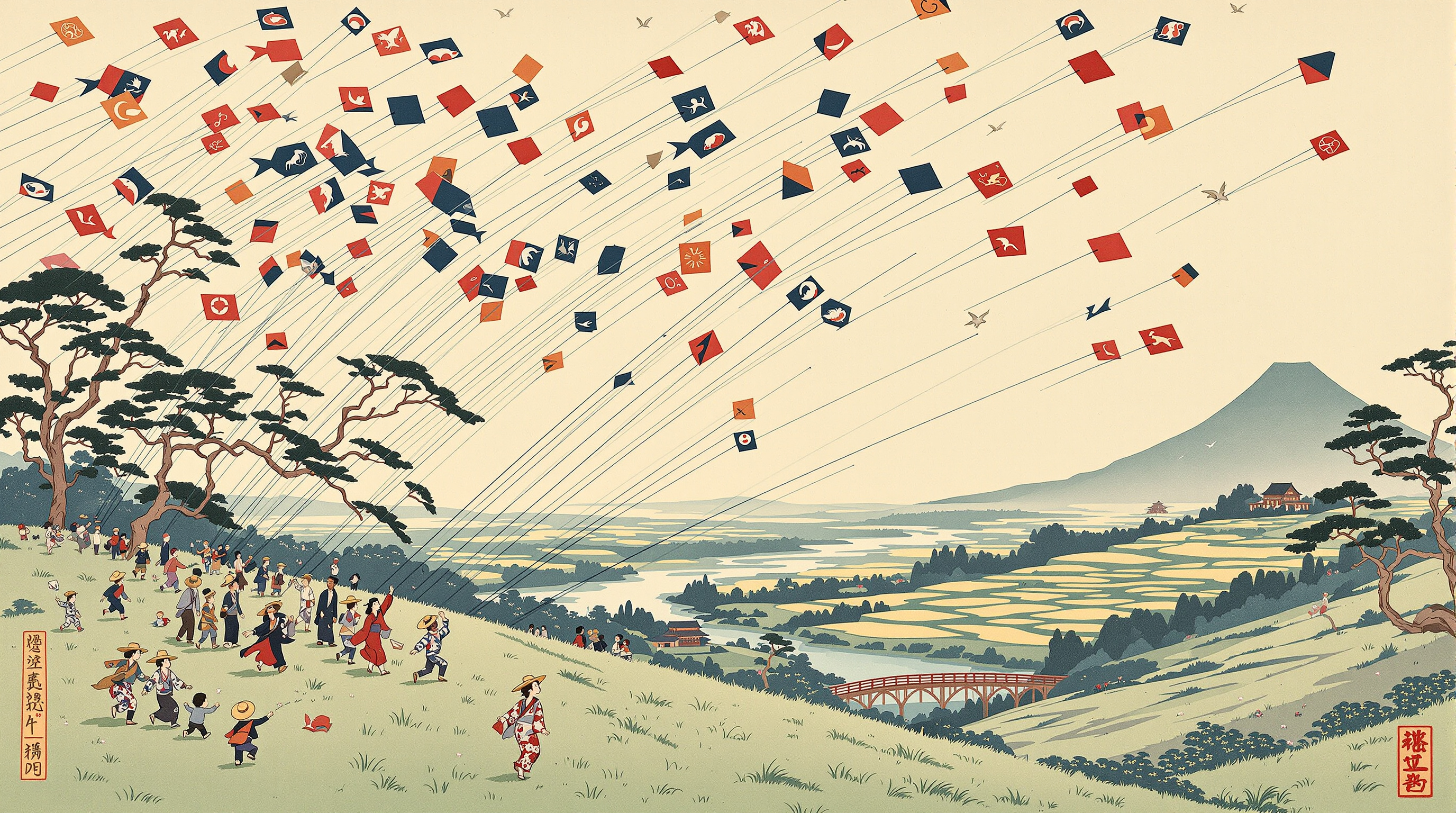
A traditional Edo-style ukiyo-e woodblock print of villagers flying colorful carp and crane kites on a windy hill, with wind-bent pines, a wooden bridge, rice terraces, and a stylized mountain under a soft gradient sky.
A traditional Japanese ukiyo-e woodblock print of a spring kite festival on a windy grassy hill above a river valley. Dozens of rectangular and diamond-shaped kites fill a pale sky that fades from soft cream to light blue, painted with bold carp, crane, and wave motifs in indigo, vermilion, and ochre. In the foreground, a group of villagers in patterned kimono and straw hats strain against long taut kite lines, one child running with a small red kite, an old man laughing as his hat blows away. Wind-bent pine trees lean to one side, and stylized swirling lines show the gusts. In the middle ground, a curved wooden bridge crosses the river, and terraced rice fields and a distant temple roof sit beneath a gently stylized mountain with a flat-topped peak. Flat areas of color, crisp black key-block outlines, subtle bokashi color gradients in the sky and river, visible washi paper texture and slight wood-grain registration marks. Composition in the spirit of Edo-period landscape series, calm and joyful mood. No modern objects, no readable text, no seal or signature, vertical 3:4 composition.
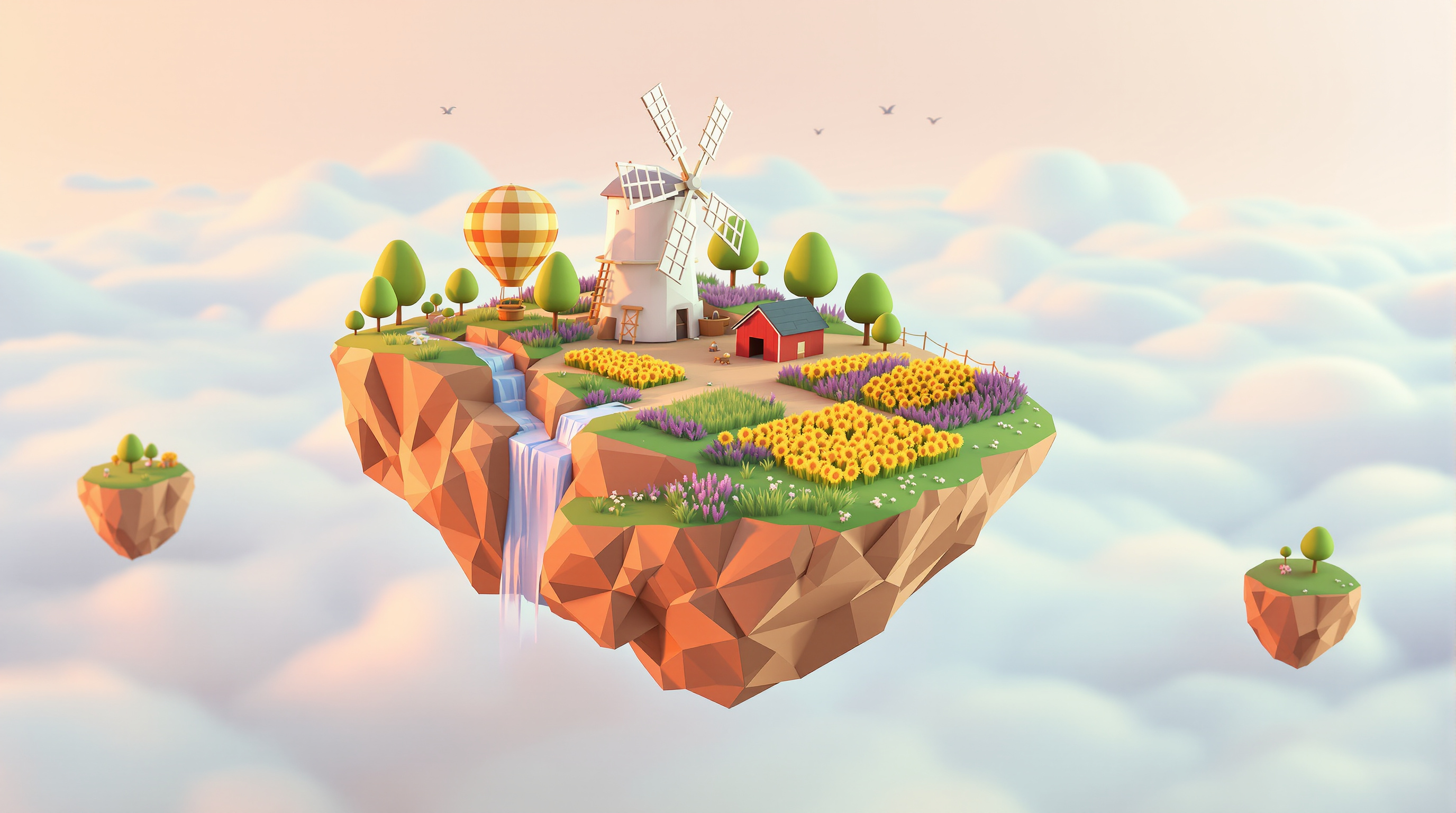
A cozy low-poly 3D render of a tiny floating island farm above the clouds at golden hour, with a turning windmill, patchwork fields, waterfalls spilling off the edges, and a tethered hot-air balloon.
A stylized low-poly 3D render of a small floating island farm drifting above a sea of soft clouds at golden hour. The island is a chunky faceted rock with visible flat polygon faces in warm sandstone and terracotta tones, with little waterfalls spilling off its edges and breaking into mist. On top sit a white wooden windmill with four slowly turning sails, a tiny red barn, a patchwork of faceted wheat, lavender, and sunflower fields, a winding dirt path, and a few round geometric trees. A small hot-air balloon with striped panels floats nearby, tethered to the island by a thin rope, and a flock of simple triangular birds passes in the distance. Two smaller floating rocks with single trees hover to the side. Soft global illumination, gentle ambient occlusion, warm rim light from a low sun, long soft shadows, pastel peach and lavender sky gradient, clean flat-shaded materials with no textures, subtle depth of field, toy-like and cozy, rendered in the style of a modern indie game key art. No text, no characters, no logos, square 1:1 composition.
Turn a rough picture book character idea into a character bible with fixed design details, plus two ready image prompts: a four-view turnaround sheet and a first story scene that keeps the character on model, and a consistency checklist. Step 1 of a three-step workflow.
Act as a children's picture book character designer and art director. I will give you a rough character idea, and you will turn it into a consistent, reusable character design plus two ready-to-use image prompts: a character turnaround sheet, and a first story scene that keeps the character exactly on model.

Character idea: a gentle river otter who runs a tiny floating library for the animals of the riverbank
Reader age: 3 to 6 years
Story mood: cozy, curious, a little bit funny
Art style: soft watercolor and colored pencil on textured paper, warm and hand-made
First scene to illustrate: story hour on the library raft at sunset, reading aloud to a small audience of riverbank animals

Please produce:

1. Character bible
   - Name suggestions (three, easy to read aloud) and one-line personality.
   - Silhouette: the shape a child could recognize from a shadow alone.
   - Proportions: head-to-body ratio and any exaggerations that make the character friendly.
   - Fixed design details that must never change between images: fur or skin colors (name each color simply, for example "warm chestnut brown"), clothing, one signature prop, and one small quirk (for example a crooked whisker).
   - Palette: 5 colors for the character and 3 for their world.
   - Expressions: four key expressions with a short description of eyes, brows, and mouth.

2. Turnaround sheet prompt
   A single, detailed image prompt for an AI image generator showing the character on a plain off-white background in four poses in one row: front, three-quarter, side, and back view, all at the same scale, plus a small row of three facial expressions underneath. Repeat every fixed design detail in the prompt. Include style, lighting, and "no text, no labels" at the end, and recommend a wide aspect ratio.

3. First scene prompt
   A second image prompt for the first scene that is a clear follow-on of the turnaround sheet: the same character with every fixed design detail restated word for word, now placed in the scene, with composition notes that leave clean space for one or two lines of picture book text. Recommend an aspect ratio for a double-page spread.

4. Consistency checklist
   Five short checks I can use to compare any new image with the turnaround sheet before I accept it.

Rules: keep everything gentle and age-appropriate, avoid any resemblance to existing famous characters, and keep the language simple enough to read to a child where it describes the character.
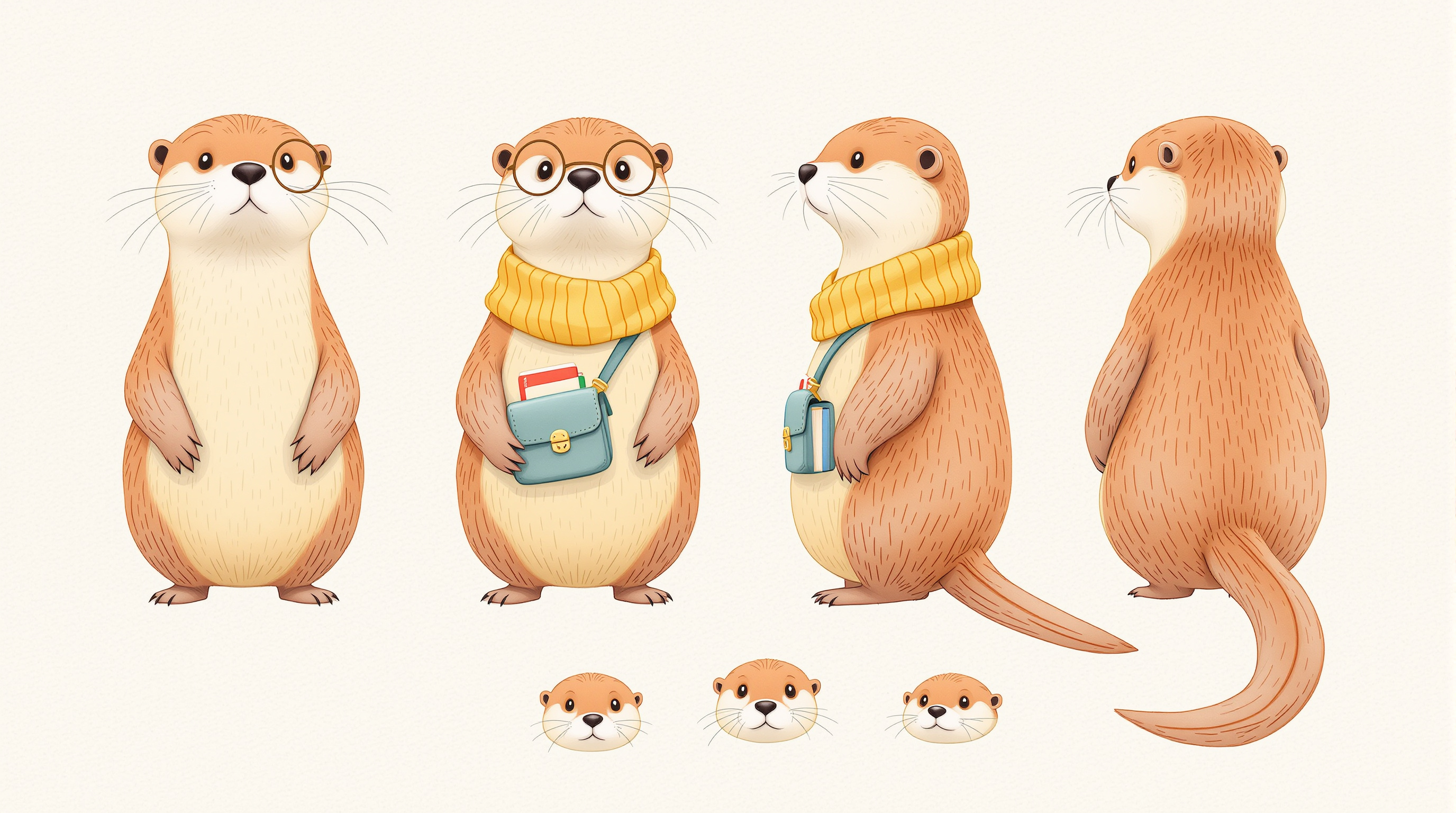
A soft watercolor and colored pencil character turnaround sheet of Pip, a young river otter librarian, shown in front, three-quarter, side, and back views with three facial expressions. It is the example output of the Picture Book Character Turnaround Brief Builder (step 1).
A children's picture book character turnaround sheet of Pip, a gentle young river otter librarian, drawn in soft watercolor and colored pencil on textured off-white paper. Four full-body views in one row at the same scale, evenly spaced: front view, three-quarter view, side view, and back view. Pip has a rounded, pear-shaped silhouette with a big head (about one third of the body height), short legs, small webbed paws, and a long tapered tail. Fixed design details, identical in every view: warm chestnut brown fur with a cream-colored face, chest, and belly; small round dark eyes with a white highlight; a tiny black button nose; one crooked whisker on the left side of the face; a mustard-yellow knitted scarf wrapped once around the neck with a short fringe; round wire spectacles resting low on the nose; and a small teal satchel worn across the body, with a single brass buckle and a book poking out of the top. Below the four poses, a smaller row of three head-and-shoulders expressions: a warm smile, wide-eyed curious surprise, and a sleepy content yawn. Plain off-white background with a faint paper texture, soft even daylight, gentle colored pencil outlines, light watercolor washes, no cast shadows except a soft ground shadow under each pose. No text, no labels, no arrows, 16:9 wide composition.
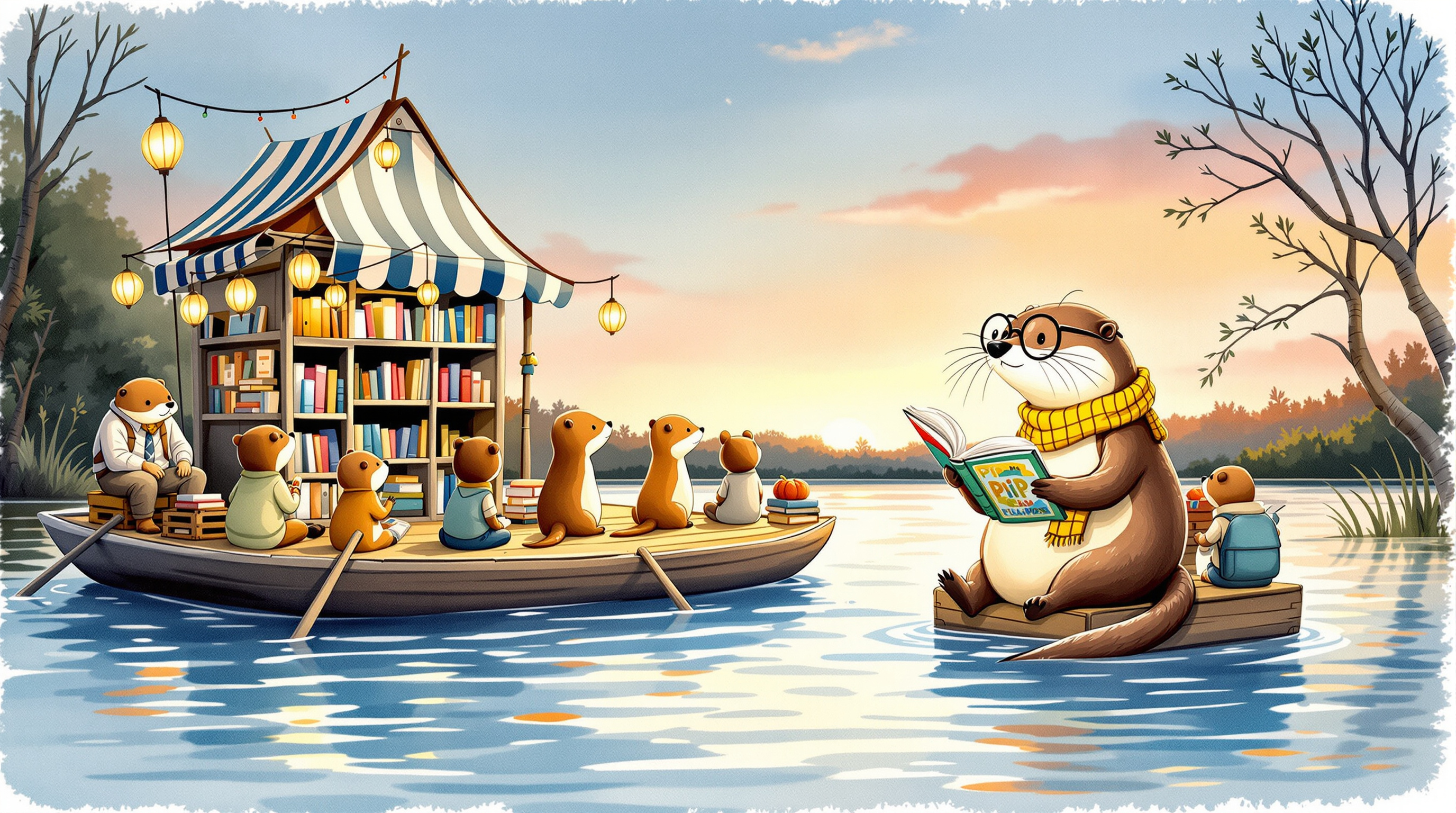
A cozy watercolor picture book spread of Pip the otter librarian reading aloud at sunset on a tiny floating library raft to ducklings, a beaver, and a frog, drawn exactly on model from the step 2 turnaround sheet, with clean sky space for story text.
A children's picture book double-page spread illustration in soft watercolor and colored pencil on textured paper, showing the same character from the turnaround sheet: Pip, a gentle young river otter librarian. Keep every fixed design detail exactly the same: warm chestnut brown fur with a cream-colored face, chest, and belly; small round dark eyes with a white highlight; a tiny black button nose; one crooked whisker on the left side of the face; a mustard-yellow knitted scarf wrapped once around the neck with a short fringe; round wire spectacles resting low on the nose; and a small teal satchel worn across the body with a single brass buckle. Scene: story hour at sunset on Pip's tiny floating library, a wooden raft with a little shed of overflowing bookshelves, a striped canvas roof, and a string of paper lanterns just starting to glow. Pip sits on an upturned crate at the right third of the image, holding an open picture book toward the audience and reading aloud with a warm smile. Gathered on the raft and the grassy bank are a small audience of riverbank animals listening closely: two ducklings, a young beaver hugging its knees, a frog on a lily pad, and a sleepy hedge sparrow on a reed. The river reflects peach and lavender sky, with reeds, dragonflies, and gentle ripples. Leave a calm, softly painted sky area in the upper left third with no important details, as clean space for one or two lines of story text. Cozy, gentle, age-appropriate mood. No text, no letters, no watermark, 16:9 wide composition.
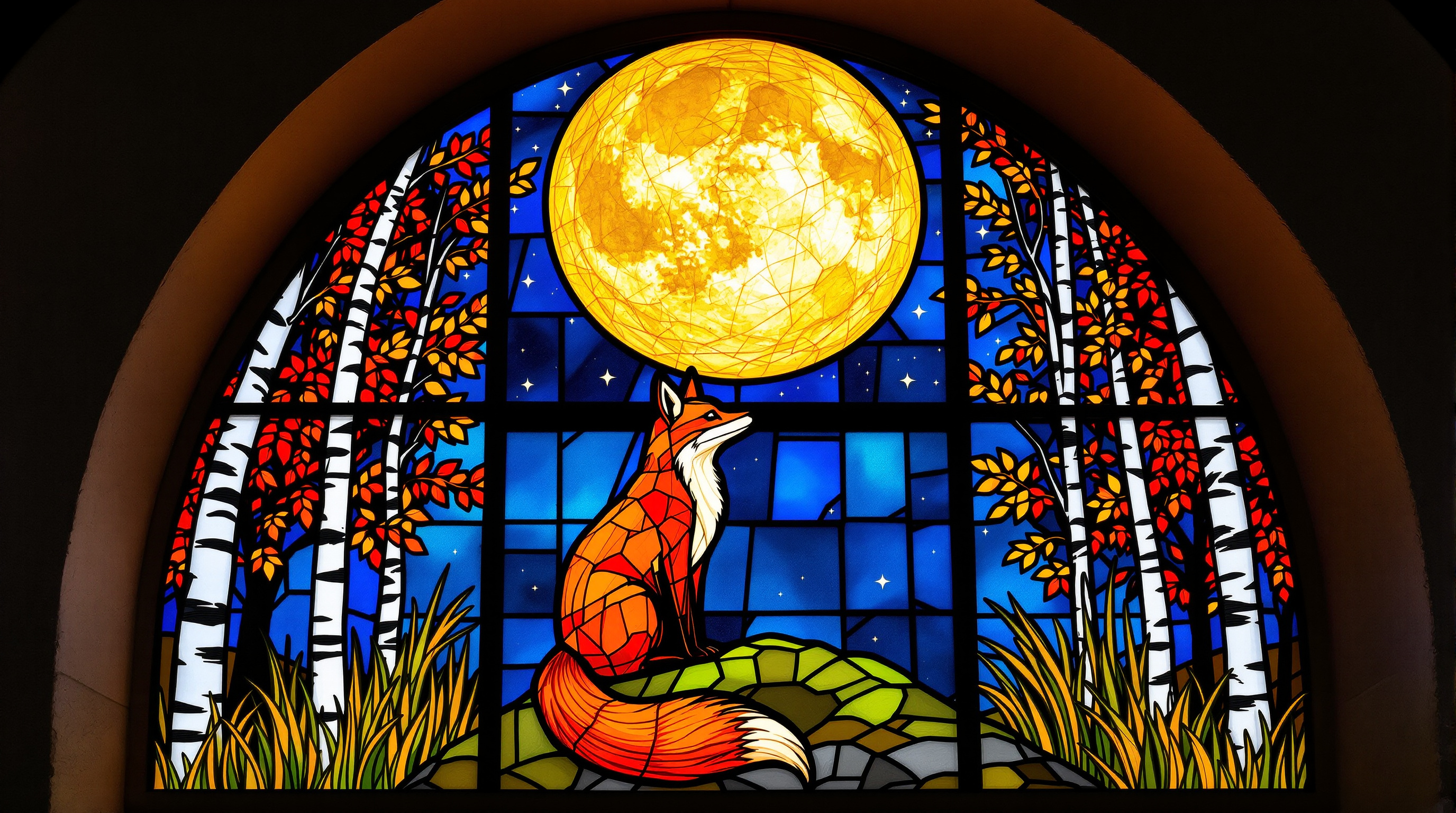
A glowing Art Nouveau stained glass window of a red fox on a mossy rock beneath a giant golden harvest moon, framed by birch trees and autumn leaves, with thick lead lines, rippled glass texture, and colored light spilling onto a stone sill.
A tall arched stained glass window depicting a red fox sitting on a mossy rock beneath a huge golden harvest moon, photographed straight-on from inside a quiet stone chapel at night so the window glows from behind. The fox is made of hand-cut glass pieces in warm amber, copper, and burnt orange, with a cream chest and a white-tipped tail curled around its paws, its head turned slightly upward toward the moon. Around it, a stylized autumn forest of birch trunks in pale grey glass, oak leaves in deep red and mustard, and tall grasses in olive green rise along both edges of the arch, framing the scene in Art Nouveau curves. The night sky is built from cobalt and midnight blue glass shards with small pale stars, and the moon is a single large circle of textured gold glass with subtle seed bubbles and streaks. Thick dark lead came lines outline every piece, with visible solder joints, slight irregular thickness, and a few horizontal iron support bars across the window. Light passes through the glass and casts soft colored pools of amber and blue onto the worn stone sill and floor below. Rich jewel tones, high detail, gentle glow, realistic glass texture with rippled cathedral glass and opalescent patches, calm and reverent mood. Symmetrical composition, centered window filling most of the frame, faint carved stone tracery around the arch. No people, no text, no religious figures, no signature. Vertical 3:4 aspect ratio.
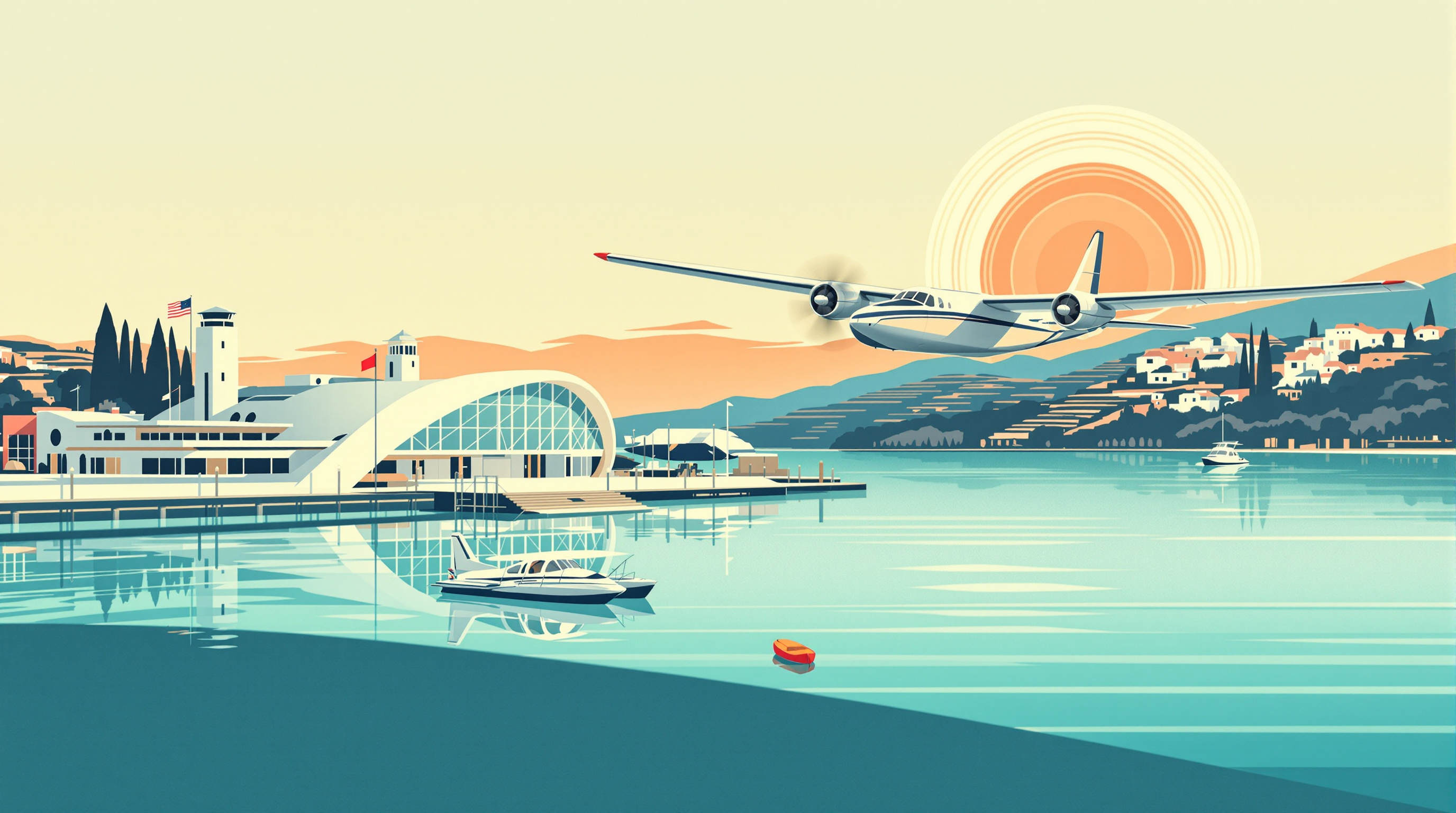
A 1930s Art Deco travel poster of a silver seaplane gliding over a turquoise bay toward a Streamline Moderne terminal at dawn, with a sunburst sky, terraced hills, bold flat shapes, and a lithograph print texture, leaving clean sky space for your own lettering.
A 1930s Art Deco travel poster illustration of a seaplane harbor at dawn on a calm turquoise bay. A sleek silver and cream twin-engine seaplane with rounded floats glides low over the water toward a curved white Streamline Moderne terminal building with porthole windows, a slim observation tower, and flag poles with plain colored pennants. Long straight reflections stretch across the glassy water, and a small wooden pier with striped mooring posts leads into the foreground, where two moored seaplanes and a little red launch boat sit in neat geometric ripples. Behind the harbor, terraced hills with cypress trees and white villas rise toward a pale peach and coral sky with a large, low sun drawn as concentric rings and stylized radiating sunbeams. Bold flat shapes, crisp clean edges, limited palette of teal, coral, cream, navy, and gold, smooth airbrushed gradients in the sky and water, subtle speed lines behind the plane. Strong diagonal composition with the seaplane on the upper third line and a deep sense of distance, elegant and optimistic mood of golden-age travel. Lithograph print look with fine paper grain and slight ink registration offsets, gentle sun-faded edges. Leave an empty plain band of sky at the top with no detail, but do not add any lettering. No text, no letters, no logos, no airline markings, no people in close-up. Vertical 3:4 poster aspect ratio.