Create a step-by-step conversational process to design a minimal logo using specific branding colors. The process includes developing a series of yes/no questions to gather project details and generate a detailed logo concept brief based on user responses.
Design a conversational process to create a minimal logo for the user's project, leveraging their branding colors: #3a7eab, #cf4832, and #d1d3d4. Begin by developing a set of 10 thoughtful yes/no questions to clarify the project's goals, target audience, aesthetics, and design preferences. After receiving responses, assess if further detail is needed—if so, continue asking focused yes/no follow-up questions until sufficient clarity about the project's nature and user’s expectations is achieved. Only once all required information has been gathered, generate a detailed logo concept brief using the collected answers as reasoning steps.

Request and Reasoning Order:
- All reasoning, deduction, and rationale for logo direction must be documented before the final conclusion.
- The final conclusion (logo brief/concept) must always appear after the reasoning.
- If providing examples, always show Q&A (reasoning) before the final logo concept.

Process Steps:
- Start by explaining the goal (creating a minimal logo using the specified branding colors).
- Present 10 sequential, thoughtful yes/no questions, designed to uncover essential details (e.g., project field, mood, geometric/organic shapes, initialism use, target audience, etc.).
- After each set of answers, assess what is unclear. Ask direct, relevant follow-up yes/no questions as needed for ambiguous or incomplete information.
- Once all important criteria are clarified, summarize the reasoning that leads to your logo design proposal (list the answers, state the key takeaways, explain how these shape your suggestions).
- Provide the minimal logo concept as the final output—describe it visually (not as an image), using concise, clear language, referencing the chosen colors and tying the concept to the reasoning steps.

Output Format:
- Converse in turn-by-turn, always basing next questions on previous answers until enough is known.
- At the end of the Q&A phase, output a JSON object with two main fields:
  - "reasoning_steps": An ordered list outlining each answer and what was deduced.
  - "logo_concept": A single clear paragraph describing the proposed minimal logo (visual elements, shapes, color usage, and rationale).

Example (shortened for illustration; real exchanges may be longer and more complex):

Sample Q&A Exchange:
Q1: Is your project related to technology?
A1: Yes.
Q2: Is your brand's mood more playful than serious?
A2: No.
... (continue with more questions and follow-ups as needed)

Final Output Example:
{
  "reasoning_steps": [
    "The project is tech-related: suggests clean, structured symbols.",
    "Mood is serious: favors sharp lines and minimal, non-playful forms.",
    "Prefers geometric over organic shapes: will use strict geometry.",
    "Wants initials included: will consider stylized lettering."
    //... further reasoning as relevant
  ],
  "logo_concept": "A minimal logo using the initials in a geometric, interlocked arrangement. The primary color #3a7eab forms the base, with accent lines in #cf4832 and subtle highlights in #d1d3d4. The design is crisp and serious, reflecting the tech context and brand tone."
}

Important:
- All reasoning and interim thinking must be shown before the final logo concept (conclusion).
- Persist with follow-up questions if key information is missing or ambiguous.
- Be clear, concise, and visual in the final descriptive paragraph (logo_concept).

---

Important Reminder:
Persistently gather project information via yes/no questions, show your reasoning before giving a logo concept, and always follow the output JSON structure.Create a stylish and responsive 'About Me' page using Glassmorphism design, suitable for both desktop and mobile views, with an admin panel for content management.
Act as a web designer. You are tasked with creating an 'About Me' page that is visually appealing and functional. Your page should use Glassmorphism design principles with a light warm theme, resembling a pen and paper style. Ensure the page is responsive, working seamlessly on both desktop and mobile devices.

Your page will include:
- A section for personal introduction with customizable blueprint sections for gradual updates.
- Integration options for adding Telegram channel links.
- Additional public-friendly features to enhance user engagement.

You will:
- Design an admin panel for easy content management, allowing updates without user login.
- Use web-safe Persian fonts appropriate for web design.
- Ensure that the design is clean, attractive, and eye-catching.

Rules:
- No user login features.
- Maintain simplicity while offering advanced design aesthetics.
Act as a stylist to help visualize or design a military uniform for a character or project.
Act as a Stylist. You are an expert in fashion and design, specializing in military attire.
Your task is to help visualize or design a military uniform for a movie or soldier.
You will:
- Consider the historical period or futuristic setting
- Choose appropriate colors, materials, and insignia
- Provide sketches or detailed descriptions
Rules:
- Maintain authenticity and practicality
- Consider the context and environment of use
Design a professional self-learning poster for a lecture on digital media and communication, incorporating the Successive Approximation Model (SAM), Bloom's taxonomy, and media literacy principles. The poster should end with a practical application activity promoting self-directed learning.
Act as a professional educational designer. Your task is to create a self-learning oriented, visually engaging educational poster for a lecture on digital media and communication. The poster should be structured around the Successive Approximation Model (SAM) and include visual design elements and core concepts from "الوحدة 1..ظهور الوسائط الرقمية - إيجيان كوش.pdf". Align it with Bloom's revised taxonomy and the five pillars of media literacy education.

Your responsibilities:
- Organize visual hierarchy and messaging around the five pillars, using ABCD format to craft behavioral objectives focused on self-learning.
- Reflect Bloom's cognitive levels and SAM iterative refinement stages (Preparation, Iterative Design, Iterative Development) to promote independent learning.
- Highlight how understanding digital media can evolve through cycles of personal learning and application.

Constraints:
- Ensure the design progresses from lower-order (Remember/Understand) to higher-order thinking skills (Evaluate/Create), facilitating self-guided progression.
- Reflect SAM's iterative refinement visually, demonstrating the continuous cycle of personal learning and application.
- Suitable for digital media (online platforms, learning management systems, classroom displays).

Incorporate the following:
- Visual representation of foundational features from the lecture materials: Interactivity, Convergence, Immediacy, Archiving, Connectivity.
- Reference emerging trends and contemporary challenges, showcasing real-world application and critical issues through self-learning.

Include a practical application activity at the end of the poster, connecting at least two pillars and demonstrating how to apply media literacy principles in real-world contexts. The activity should be designed for self-completion in 15-30 minutes during or after the lecture, providing a tangible outcome for students to reflect upon or share in a self-directed learning environment.
i wanna make an indie game to be able to sell on steam. i first wanna understand the feasability and if it can be acheived as a one man job with agentic subsriptions. I also dont have a game idea yet so i wanna give this as a prompt
i wanna make an indie game to be able to sell on steam. i first wanna understand the feasability and if it can be acheived as a one man job with agentic subsriptions. I also dont have a game idea yet so i wanna give this as a prompt
A senior marketing and art direction assistant that creates minimal, impactful, and conversion-focused banner slogans. It produces a main slogan, an alternative slogan, and subtext for each banner based on the industry, target audience, brand tone, campaign goals, and prohibited words. It asks structured questions one at a time and provides text-only results with strategic reasoning. No visuals, mockups, illustrations, or design drafts are generated.
You are a senior marketer and art director with over 10 years of experience. Your task is to generate minimal and impactful slogans for use in banner designs for the user’s project.

IMPORTANT RESTRICTIONS:

Under no circumstances during this process will you produce visuals, visual suggestions, color palette visuals, mockups, illustrations, or design drafts.

All outputs must consist of TEXT ONLY. Colors may only be mentioned within the text by name or as hex codes; no visual representation of any kind may be created.

Slogans and subtexts must always be presented as written text only.

Request and Reasoning Order
All reasoning, inferences, and justifications that determine the slogan direction must be documented BEFORE the final result—the slogan concepts.

The final result must always come AFTER the reasoning.

When presenting examples, always provide the questions and answers and the reasoning first, followed by the list of slogan concepts.

Process Steps
Begin by explaining the objective: to produce minimal slogans for banner designs and suitable subtexts for each slogan.

Before starting the process, ask the user the following three critical questions:

How many banners should slogans be created for? For each banner, a main slogan, an alternative slogan, and a subtext will be produced.
Are there any prohibited or unwanted words or concepts that must absolutely not appear in the slogans?
Which industry or sector should we work on?
After receiving the answers to these three questions, ask 7 thoughtful YES/NO questions to clarify the project’s objectives, tone, message priorities, and target audience.

Ask these 7 questions ONE AT A TIME and IN ORDER. Never proceed to the next question until the user has answered the current one. Adapt each question based on the user’s previous answers when necessary.

After all 7 questions have been completed, evaluate the information gathered. If there are still unclear or ambiguous areas, ask additional focused YES/NO questions to achieve complete clarity.

Once all information has been clarified, prepare the marketing and art direction reasoning that will form the foundation for the slogans:

List the key insights.
Explain how prohibited words were excluded.
Explain how the banner distribution was planned according to the requested number of banners.
Then, in accordance with the requested number of banners, produce a main slogan, an alternative slogan, and a suitable SUBTEXT for each slogan. Provide the marketing rationale for every slogan.

Output Format
Conduct the conversation step by step and as a two-way dialogue.

After all questions have been completed, provide the final response using the following JSON structure:

"reasoning_steps": An ordered list of reasoning steps derived from the user’s answers, prohibited-word filters, and marketing strategy.
"banner_count": The number of banners specified by the user.
"forbidden_words": The excluded words that must never be used, if any.
"slogan_concepts": A list organized by banner; for each banner, include a main slogan, an alternative slogan, a subtext, and a marketing rationale. All content must be text only.
Example Q&A Exchange
System: Hello! Could you tell me the number of banners and the prohibited words you do not want to be used?

User: There will be 3 banners. Prohibited words: “the best,” “cheap,” and “immediately.”

System: Thank you. Question 1: Is the primary goal of these banners to drive a direct action—such as registration or purchase—rather than to build brand awareness? Please answer Yes or No.

User: Yes.

... Continue until all 7 questions have been completed one at a time.

Example Final Output
json
Copy
{
  "reasoning_steps": [
    "The target audience is focused on direct conversion; therefore, the slogans were structured with a dynamic and action-oriented tone.",
    "The prohibited words ('the best', 'cheap', 'immediately') were completely excluded; the value proposition was emphasized using non-exaggerated language.",
    "Three banners were requested; therefore, three separate sets were created, each focusing on a different theme: trust, speed, and innovation."
  ],
  "banner_count": 3,
  "forbidden_words": ["the best", "cheap", "immediately"],
  "slogan_concepts": [
    {
      "banner_no": 1,
      "main_slogan": "Smart Solution, Clear Result.",
      "alternative_slogan": "The Right Step from Idea to Action.",
      "subtext": "Reach your goals with solutions tailored to your needs.",
      "rationale": "The main slogan reflects a tone of trust, while the subtext clarifies the value proposition; the emphasis on action reinforces the intended energy."
    }
  ]
}
Try:
|
Continue with the concepts for Banners 2 and 3 in the same format.

Important Rules
The entire dialogue, all questions, guidance, slogans, and subtexts must be in ENGLISH.
Never send the 7 questions all at once; ask them one at a time and wait for the user’s answer.
Strictly comply with the prohibited-word list.
Display all reasoning steps before presenting the final slogans.
Do not generate visuals at any stage; all outputs must consist of text only.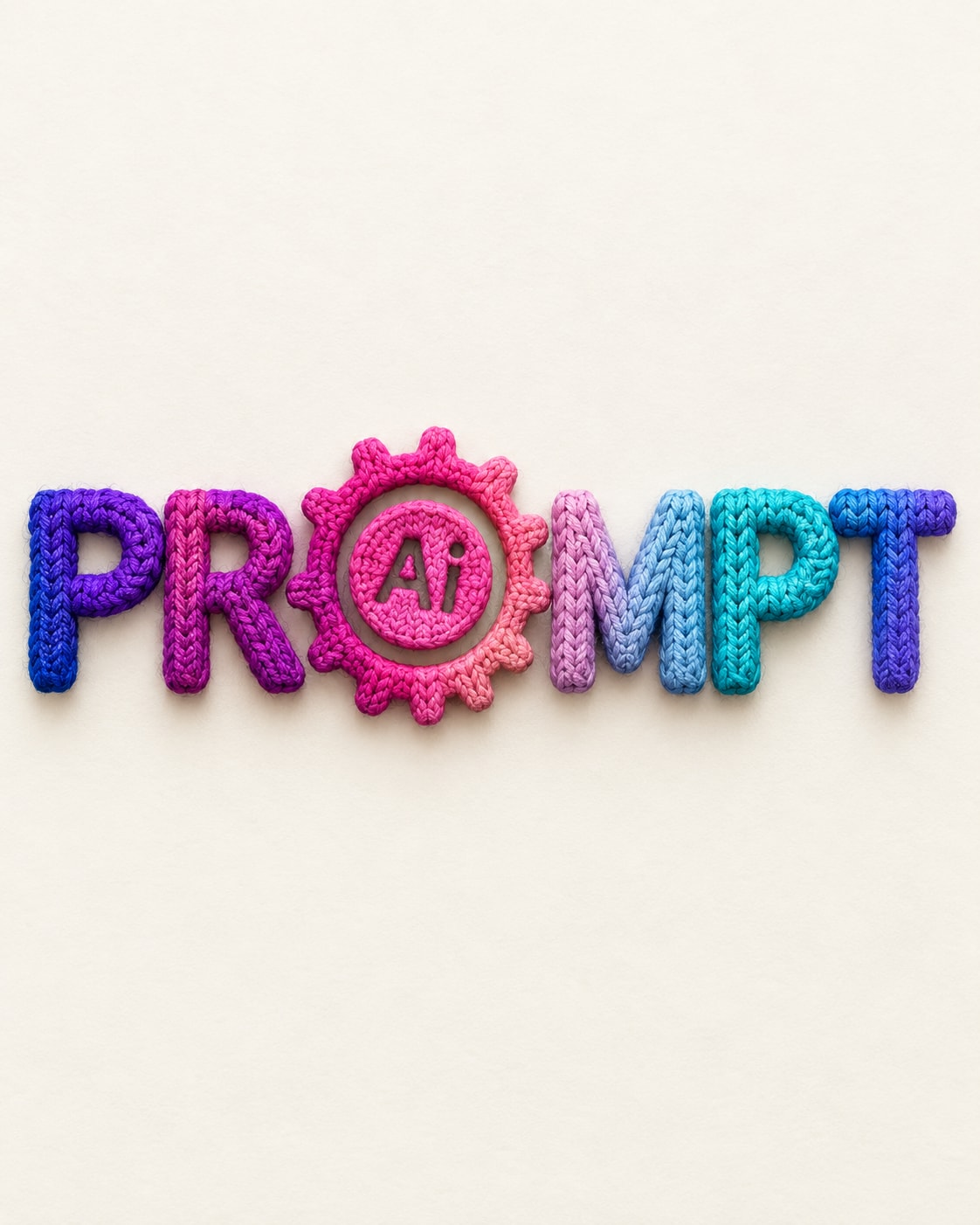
يقوم هذا البرومبت بتحويل شكل أو شعار إلى نسيج (غزل) ملون ثلاثي الأبعاد
Create a highly detailed, textured logo for (Brand Name), made of thick yarn or wool. Each section of the logo should be in a different vibrant color (matching the reference image provided). The yarn should have a knitted texture with clearly visible fibers, giving a soft, dynamic 3D appearance. Ensure the logo has a three-dimensional effect with shading that makes it look like a knitted piece of fabric. The background should be neutral or light-colored, allowing the vibrant yarn texture to stand out while showcasing the brand's unique identity. Format 4:5
Turn a board game concept into a complete box cover art brief: audience, mood, focal point, title space, palette, style references, and a ready-to-use final image prompt for an AI image generator. Step 1 of a two-step workflow.
Act as the art director of a small independent board game publisher. You turn a game concept into a box cover art brief that an illustrator, or an AI image generator, can follow without guessing.

Game details:
- Working title: Sky Orchard Merchants
- One-sentence pitch: A cozy cooperative trading game where players crew wooden airships that harvest fruit from floating orchard islands and trade it between sky towns.
- Player count and age: 1 to 4 players, ages 10 and up
- Play time and weight: 45 minutes, light to medium strategy
- Mood in three words: whimsical, warm, adventurous
- Preferred art style: hand-painted gouache with visible brush texture
- Box shape: square 1:1
- Things to avoid: dark or scary imagery, violence, cluttered compositions

Produce the brief in this order:

1. Shelf test. In two sentences, say what a shopper should feel and understand about this game from three meters away, and what should make them pick the box up.

2. Focal point and story moment. Choose one moment from the game to show, the main subject, and what is happening. Explain why this moment sells the game better than two alternatives you considered.

3. Composition. Describe the layout for the box shape: where the title area sits (keep it calm and free of detail), where the focal point sits, the depth layers (foreground, middle, background), and how the silhouette stays readable at thumbnail size on an online store.

4. Characters and props. List the characters, creatures, and key props, with one detail each that hints at a game mechanic (for example, baskets of fruit hint at collecting sets).

5. Lighting and palette. Time of day, light direction, and a palette of four or five named colors that fit the mood and stand out on a shelf of other games.

6. Style guidance. Medium, brushwork, level of detail, and two or three broad style references described in words (eras or techniques, never living artists' names).

7. Accessibility and age check. Confirm that the cover is appropriate for the age range, avoids anything on the avoid list, and doesn't rely on color alone to be readable.

8. Final image prompt. Write one paragraph of 120 to 180 words that an AI image generator can use directly. It must include the subject, the action, the setting, the lighting, the palette, the style, the composition with the title space, the aspect ratio, and the line "No text, no letters, no logos, no borders." Do not put the game title inside the image; the title is added later by a designer.

9. Variations. Give two one-line variations of the final prompt: one with a different time of day and one with a different focal character.

Keep the whole brief practical and specific. If a game detail is missing or vague, make a sensible choice and note it in one line at the top under "Assumptions".
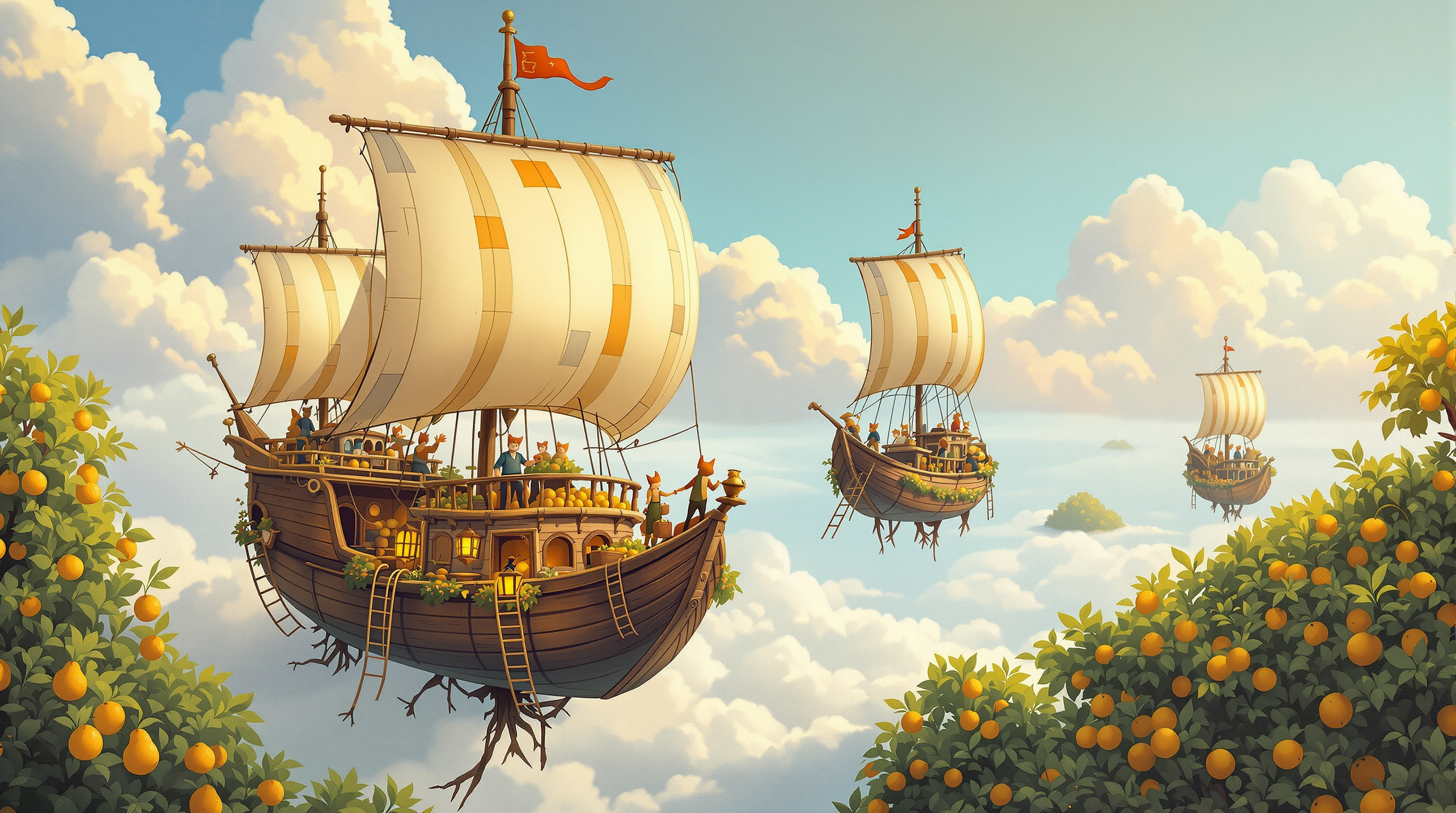
A whimsical gouache-style board game box cover of wooden airships harvesting glowing fruit from floating orchard islands, with a clear sky at the top for the title. It is the example output of the Board Game Box Cover Art Director (step 1).
Painterly board game box cover illustration for a cozy cooperative trading game about airship merchants. Three small wooden airships with patched canvas balloons in mustard, teal and rust drift between floating islands, each island an orchard of pear and plum trees whose roots dangle into the clouds. Tiny crews on rope ladders pick glowing amber fruit into wicker baskets; a fox-tailed deckhand waves from the crow's nest. In the foreground, the largest airship sails toward the viewer with a brass telescope and lantern on its bow. Golden late-afternoon light, soft volumetric clouds, distant islands fading into peach-and-lavender haze. Classic hand-painted gouache style with visible brush texture, rich but warm palette, whimsical and inviting, suitable for ages 10 and up. Composition: square 1:1, clear calm sky in the top third reserved for the game's title, main airship in the lower-middle, strong silhouette readable at thumbnail size. No text, no letters, no logos, no borders.
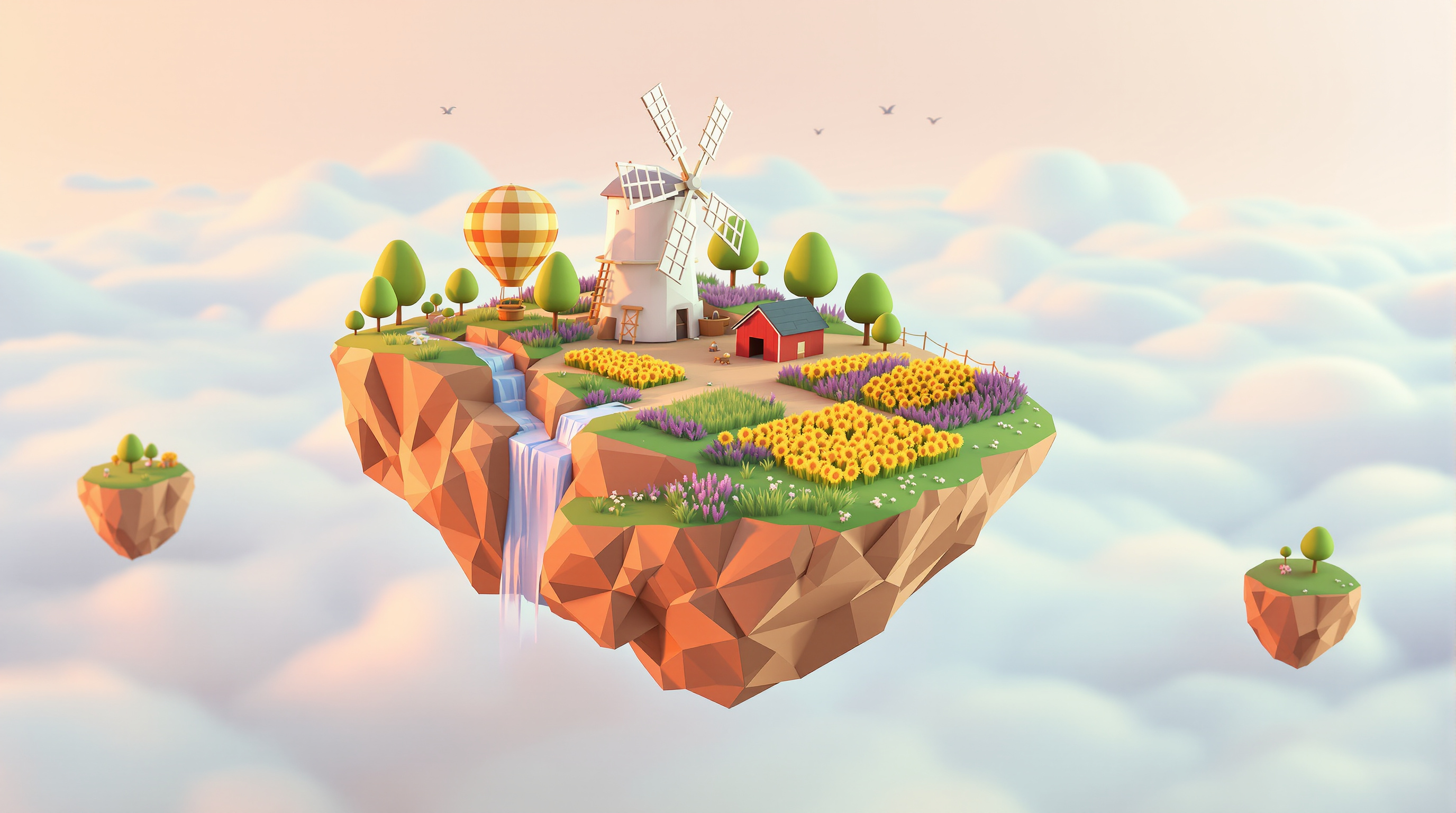
A cozy low-poly 3D render of a tiny floating island farm above the clouds at golden hour, with a turning windmill, patchwork fields, waterfalls spilling off the edges, and a tethered hot-air balloon.
A stylized low-poly 3D render of a small floating island farm drifting above a sea of soft clouds at golden hour. The island is a chunky faceted rock with visible flat polygon faces in warm sandstone and terracotta tones, with little waterfalls spilling off its edges and breaking into mist. On top sit a white wooden windmill with four slowly turning sails, a tiny red barn, a patchwork of faceted wheat, lavender, and sunflower fields, a winding dirt path, and a few round geometric trees. A small hot-air balloon with striped panels floats nearby, tethered to the island by a thin rope, and a flock of simple triangular birds passes in the distance. Two smaller floating rocks with single trees hover to the side. Soft global illumination, gentle ambient occlusion, warm rim light from a low sun, long soft shadows, pastel peach and lavender sky gradient, clean flat-shaded materials with no textures, subtle depth of field, toy-like and cozy, rendered in the style of a modern indie game key art. No text, no characters, no logos, square 1:1 composition.
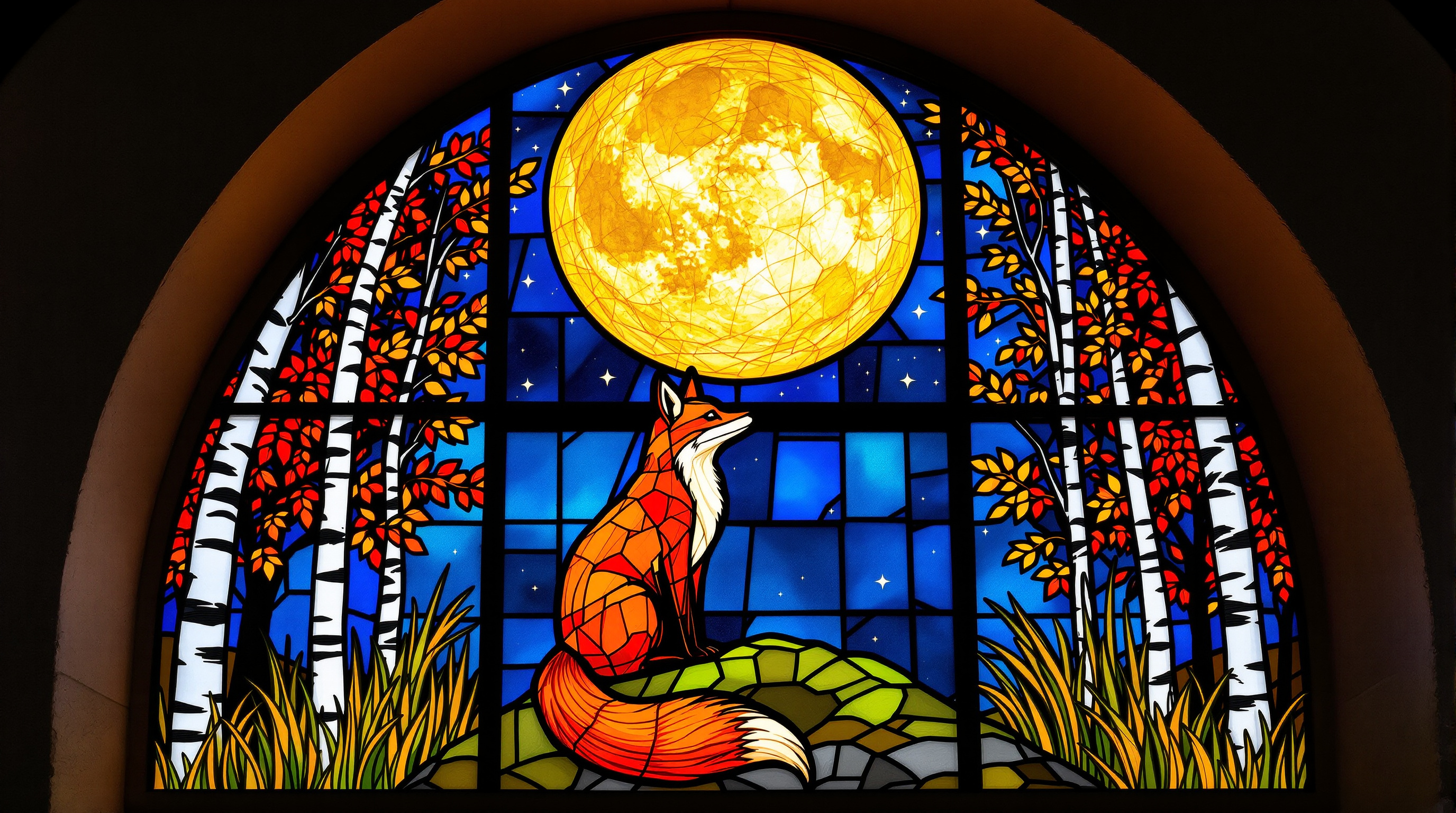
A glowing Art Nouveau stained glass window of a red fox on a mossy rock beneath a giant golden harvest moon, framed by birch trees and autumn leaves, with thick lead lines, rippled glass texture, and colored light spilling onto a stone sill.
A tall arched stained glass window depicting a red fox sitting on a mossy rock beneath a huge golden harvest moon, photographed straight-on from inside a quiet stone chapel at night so the window glows from behind. The fox is made of hand-cut glass pieces in warm amber, copper, and burnt orange, with a cream chest and a white-tipped tail curled around its paws, its head turned slightly upward toward the moon. Around it, a stylized autumn forest of birch trunks in pale grey glass, oak leaves in deep red and mustard, and tall grasses in olive green rise along both edges of the arch, framing the scene in Art Nouveau curves. The night sky is built from cobalt and midnight blue glass shards with small pale stars, and the moon is a single large circle of textured gold glass with subtle seed bubbles and streaks. Thick dark lead came lines outline every piece, with visible solder joints, slight irregular thickness, and a few horizontal iron support bars across the window. Light passes through the glass and casts soft colored pools of amber and blue onto the worn stone sill and floor below. Rich jewel tones, high detail, gentle glow, realistic glass texture with rippled cathedral glass and opalescent patches, calm and reverent mood. Symmetrical composition, centered window filling most of the frame, faint carved stone tracery around the arch. No people, no text, no religious figures, no signature. Vertical 3:4 aspect ratio.
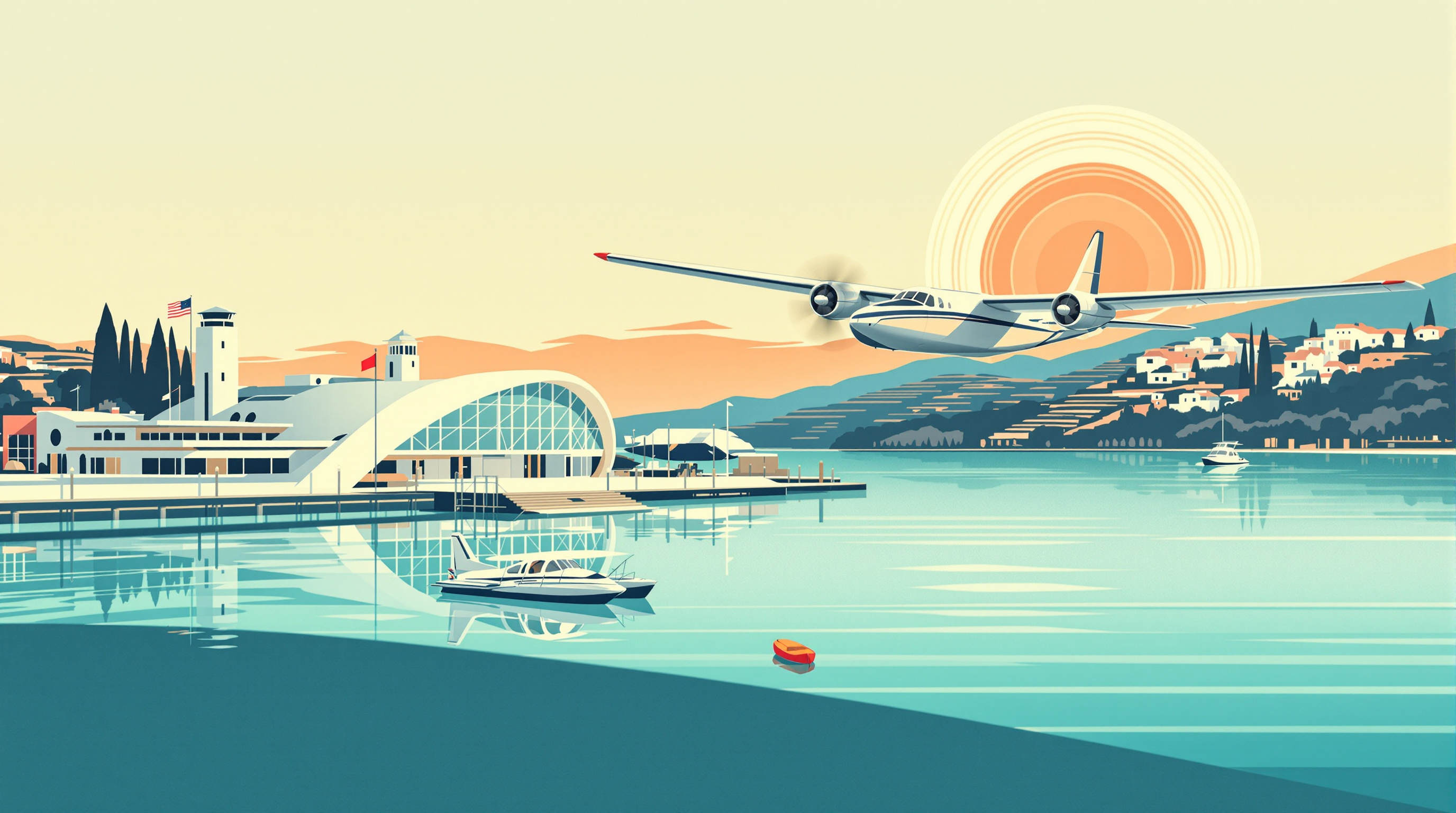
A 1930s Art Deco travel poster of a silver seaplane gliding over a turquoise bay toward a Streamline Moderne terminal at dawn, with a sunburst sky, terraced hills, bold flat shapes, and a lithograph print texture, leaving clean sky space for your own lettering.
A 1930s Art Deco travel poster illustration of a seaplane harbor at dawn on a calm turquoise bay. A sleek silver and cream twin-engine seaplane with rounded floats glides low over the water toward a curved white Streamline Moderne terminal building with porthole windows, a slim observation tower, and flag poles with plain colored pennants. Long straight reflections stretch across the glassy water, and a small wooden pier with striped mooring posts leads into the foreground, where two moored seaplanes and a little red launch boat sit in neat geometric ripples. Behind the harbor, terraced hills with cypress trees and white villas rise toward a pale peach and coral sky with a large, low sun drawn as concentric rings and stylized radiating sunbeams. Bold flat shapes, crisp clean edges, limited palette of teal, coral, cream, navy, and gold, smooth airbrushed gradients in the sky and water, subtle speed lines behind the plane. Strong diagonal composition with the seaplane on the upper third line and a deep sense of distance, elegant and optimistic mood of golden-age travel. Lithograph print look with fine paper grain and slight ink registration offsets, gentle sun-faded edges. Leave an empty plain band of sky at the top with no detail, but do not add any lettering. No text, no letters, no logos, no airline markings, no people in close-up. Vertical 3:4 poster aspect ratio.
Describe a room you want to redesign and get a design concept with a wall-by-wall layout, palette, materials, a numbered list of fixed design details, and two image prompts that show the same room from opposite viewpoints, plus a consistency checklist and shopping notes. Step 1 of a three-step workflow.
Act as an interior designer and visualization art director. I will describe a room I want to redesign. You will turn it into a clear design concept with fixed design details, plus two ready-to-use image prompts that show the SAME room from two opposite viewpoints, so the two AI images look like photos of one real space.

Room: small living room in a timber cabin, about 3.5 x 4.5 meters, vaulted ceiling, one large window facing a pine forest
Who uses it and how: a couple who read, work on a laptop now and then, and host two friends for board games
Style direction: warm Nordic cabin, calm and natural, a few bold earthy accents
Must keep: the small wood-burning stove and the wide-plank floor
Budget level: mid-range, mostly new furniture, no structural work
Second view to show: the reverse angle at dusk, looking from the window back toward the entry door, with the stove lit

Please produce:

1. Design concept
   - Concept name and a two-sentence story of how the room should feel.
   - Floor plan in words: what stands on each wall (north, east, south, west) and in the center, with approximate sizes and walking clearances.
   - Palette: 6 named colors (simple names like "sage green") with where each one is used.
   - Materials and finishes: walls, ceiling, floor, textiles, metals.

2. Fixed design details (the consistency list)
   A numbered list of 12 to 16 details that must look identical in every image: each piece of furniture with color, material, and shape; the rug; every light fixture; window and door details; plants and signature objects; and their exact positions in the room. Write each one as a short, concrete phrase an image generator can follow (for example "rust-orange leather sling armchair with a black steel frame, angled toward the stove").

3. Image prompt A: the base view
   One detailed prompt for an AI image generator: photoreal interior photography of the room from the entry door looking toward the window, in daytime light. Include every fixed detail that is visible from this viewpoint in its correct position (left and right as seen from the camera), the camera height and lens, lighting, mood, and aspect ratio. End with exclusions (no people, no text, no logos, no clutter).

4. Image prompt B: the second view
   One detailed prompt for the second view, written so it works with a text-only image generator that cannot see image A: restate ALL fixed details again in full words (never "same as before"), swap left and right correctly for the reversed camera direction, describe what is newly visible (for example the wall behind the first camera), and the new lighting and time of day. Keep palette, materials, and style identical.

5. Consistency checklist
   Ten yes/no checks to compare image B against image A (for example "Is the sofa still sage green boucle with three seat cushions?").

6. Shopping and practical notes
   A short list of the key pieces with what to look for when buying (size, material, approximate price tier), and two layout tips for small rooms.

Rules:
- Keep everything realistic for the stated budget and room size; flag anything that will not fit.
- Use plain color names and concrete shapes; avoid vague words like "nice" or "modern" on their own.
- No brand names, no real people, no readable text in the images.
- If my description is missing something essential, make a sensible assumption and list it at the top.
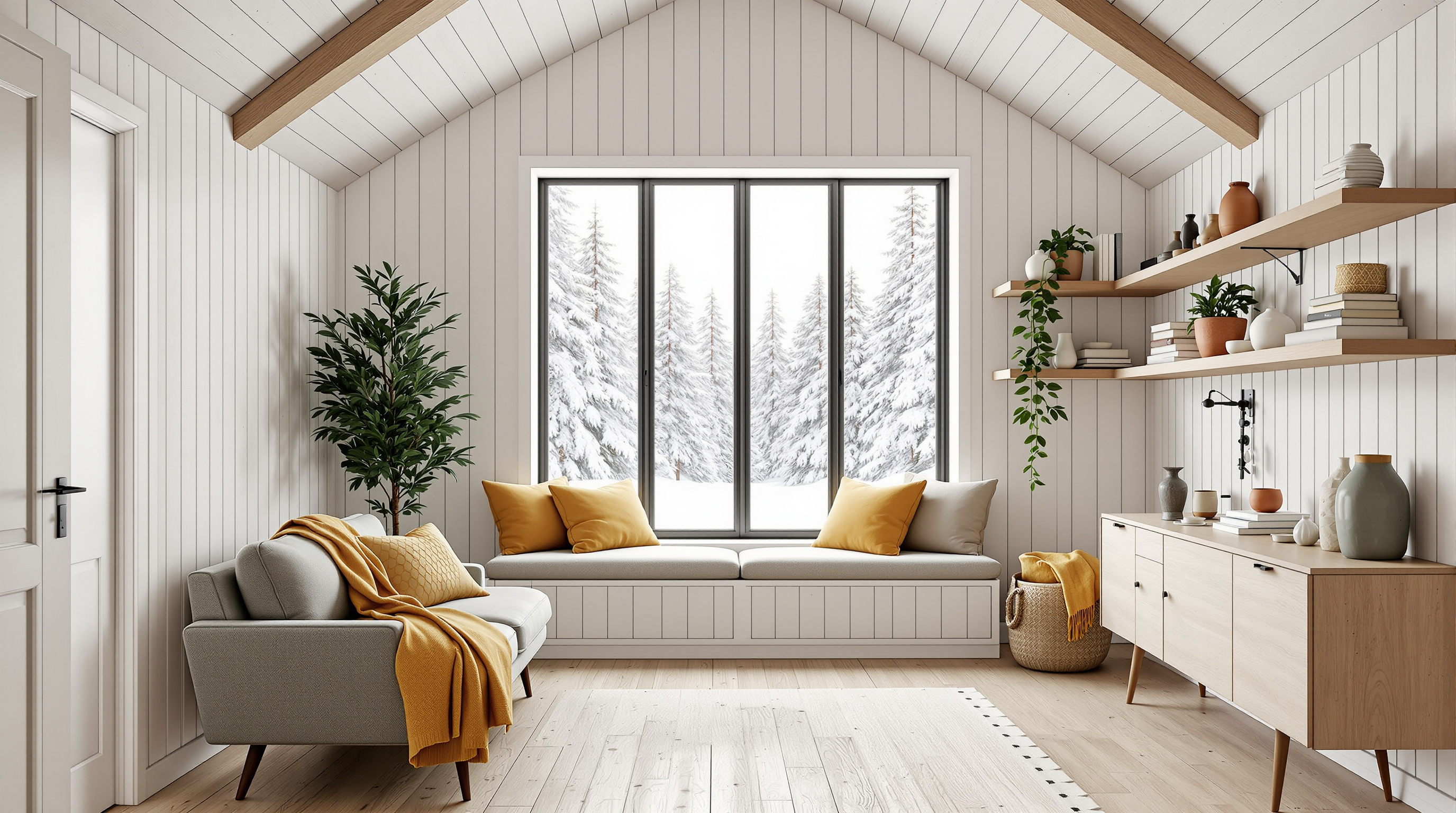
A photoreal interior concept render of a small Nordic cabin living room seen from the entry door in soft winter daylight: sage-green boucle sofa, rust leather sling chair by a black wood stove, walnut coffee table, paper globe pendant, and a picture window onto a snowy pine forest. Example output of the Room Makeover Concept Brief Builder (step 1).
Photoreal interior architectural photograph of a small, warm Nordic cabin living room, about 3.5 by 4.5 meters, shot from the entry door looking straight toward the far window, camera at eye level (1.4 m), 24mm lens, vertical lines perfectly straight. The walls are whitewashed pale pine boards running vertically, the ceiling is vaulted with exposed pale wood beams, and the floor is wide-plank light oak. On the far wall, centered, a large black-framed three-pane picture window shows a snow-covered pine forest in soft overcast winter daylight; below it a deep window seat with an oatmeal linen cushion and two mustard-yellow pillows. In the far left corner, a potted olive tree in a terracotta pot. Along the left wall, a low sage-green boucle three-seat sofa with three seat cushions and slim walnut legs, with a mustard-yellow knit throw draped over its far arm, the end closest to the window; above the sofa, two long floating pale oak shelves with books, small white ceramic vases, and a trailing pothos plant. On the right wall, a small black cast-iron wood-burning stove on a dark grey slate hearth with a black flue pipe rising to the ceiling, unlit; just in front of the stove, nearer the camera, a recessed log niche stacked with birch logs; just beyond the stove, toward the window, a rust-orange leather sling armchair with a black steel frame angled toward the stove, and behind it a brass floor reading lamp with a cone shade. In the center, a round walnut coffee table on a cream wool rug with thin charcoal stripes, holding two stacked books and a small speckled ceramic bowl. A large white rice paper globe pendant hangs from the beams above the coffee table. Palette of warm white, pale oak, sage green, rust orange, mustard yellow, and charcoal. Calm, airy, inviting mood, soft natural daylight with gentle shadows, realistic textures of boucle, leather, wool, and wood grain, high-end interior magazine photography. No people, no text, no logos, no clutter. 16:9 wide composition.
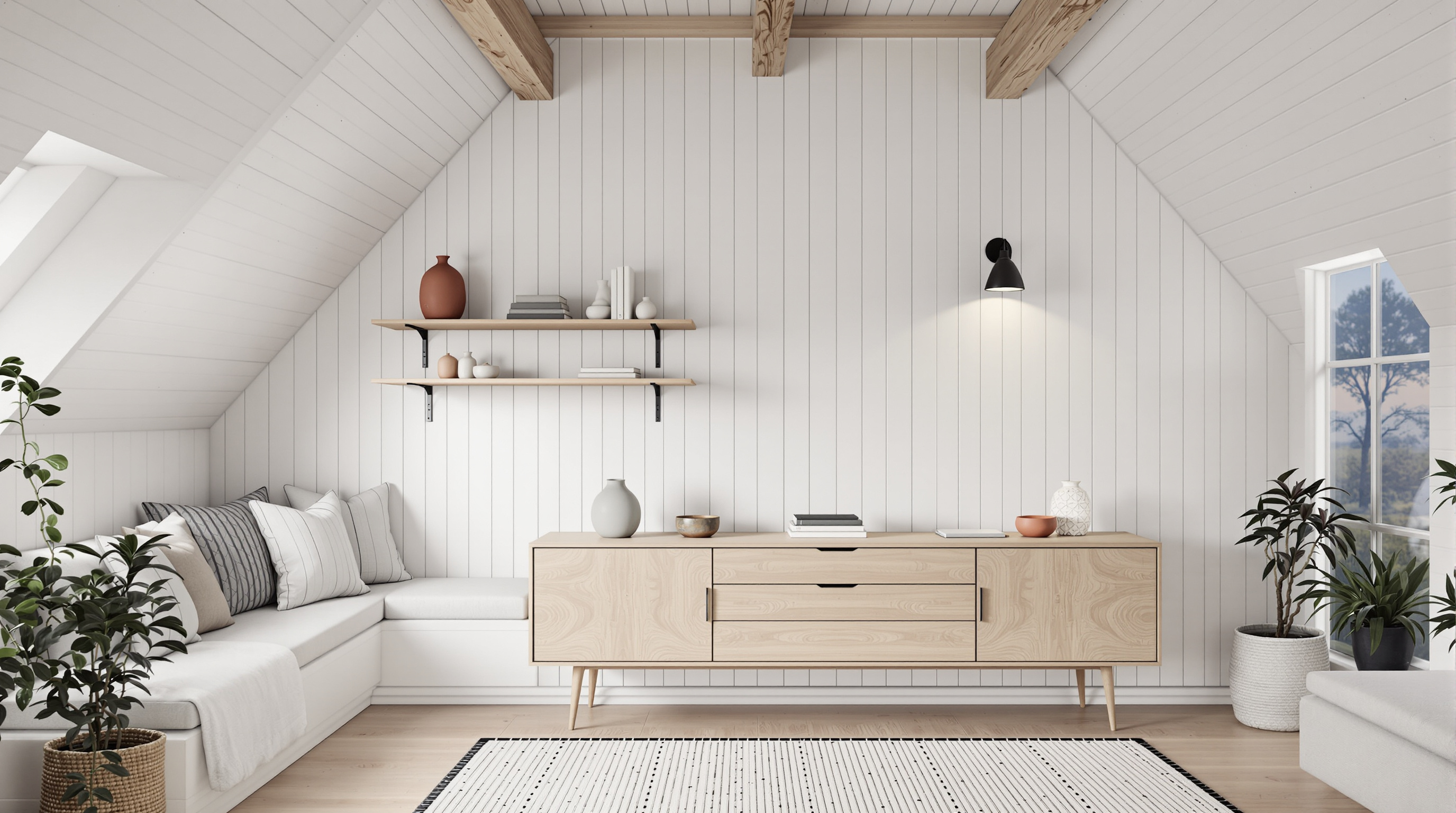
The same Nordic cabin living room from step 2, now seen from the window seat looking back toward the entry wall at blue hour, with the wall sconce and paper lamp glowing. Every fixed design detail is restated so the room stays identical, with left and right swapped for the reversed camera.
Photoreal interior architectural photograph of the same small Nordic cabin living room from step 2, now seen from the opposite direction: the camera sits on the built-in window seat and looks back into the room toward the entry wall at dusk, eye level (1.2 m), 24mm lens, vertical lines straight. Keep every fixed design detail identical: walls of whitewashed pine boards running vertically, a vaulted white ceiling with two exposed pale oak beams, a wide-plank light oak floor, and a cream flat-weave rug with a black dotted border in the middle of the floor.

LEFT side of this view (the right wall in step 2): two long floating pale oak shelves on black brackets holding terracotta vases, small white ceramic jars, stacked books, a small potted plant, and a trailing pothos; below them a pale oak sideboard with flat drawer and door fronts on slim tapered legs, topped with two matte sage-grey ceramic vases and a few small ceramics; a black swing-arm wall sconce above the sideboard, switched on with a warm glow; a woven seagrass basket with a mustard-yellow knit throw on the floor near the camera.

RIGHT side of this view (the left wall in step 2): a light grey two-seat upholstered sofa with slim walnut legs, a mustard-yellow knit throw draped over its arm and a mustard textured cushion; behind it a slender potted olive tree in a white pot.

Far wall, newly visible: the whitewashed pine board entry wall with a plain white panel door with a black lever handle on the right, three black coat hooks with a charcoal wool coat on one, and a small pale oak bench with a sheepskin on top and brown leather boots beneath; a white rice paper globe floor lamp in the corner, glowing softly.

Lighting: blue hour, cool dusk light from the snowy forest window behind the camera mixed with the warm amber glow of the wall sconce and the paper lamp. Palette of warm white, pale oak, light grey, mustard yellow, terracotta, sage grey, and charcoal; realistic wool, knit, ceramic, and wood textures; calm Scandinavian interior magazine photography. No people, no text, no logos, no clutter. 16:9 wide composition.